


Is It Safe to Date Online in Japan? How AI-Powered Matching Changes the Experience (2026)
 June 19, 2026
Online dating in Japan has a reputation for being safer than in many other countries — and broadly, that reputation is earned. Violent crime related to dating apps is rare. Scam operations are less pervasive than in some other Asian markets. And Japan's cultural emphasis on social harmony means that overtly aggressive or threatening behavior on apps is less common than on Western platforms.
But "safer than some alternatives" isn't the same as safe. And for foreign users in particular — less familiar with the cultural signals that help locals identify red flags — the risks deserve honest attention.
This guide covers what the real safety concerns are for online dating in Japan in 2026, what existing platforms do (and don't do) to address them, and how AI-powered matching changes the safety equation in ways that traditional verification approaches don't.
Table of Contents
The Real Safety Concerns in Japan Online Dating
What Traditional Japanese Dating Apps Do for Safety
Where Traditional Approaches Fall Short
How AI-Powered Matching Changes the Safety Equation
Practical Safety Guidelines for Online Dating in Japan
How Safety Concerns Should Influence App Choice
The Bottom Line

The Real Safety Concerns in Japan Online Dating
Fake Profiles and Identity Misrepresentation
The most common safety issue on Japanese dating apps isn't physical danger — it's fake or misrepresented profiles. This takes several forms:
Catfishing — profiles using photos of someone other than the actual user, often attractive stock photos or images scraped from social media. More common on less-verified platforms.
Intent misrepresentation — real people presenting themselves as marriage-minded or serious when they're actually looking for something casual, or vice versa. Technically not a scam, but a significant source of wasted time and emotional investment.
Promotional accounts — profiles created not for genuine dating but to funnel users toward paid services, social media follows, or other commercial interests. Less common on paid apps with verification, more common on free apps.
Partial misrepresentation — real profiles where key information (relationship status, age, profession, location) is fabricated or omitted. Hard to verify and very common across all platforms.
Scam Operations Targeting Foreign Users
Foreign users on Japanese dating apps face a specific risk that local users encounter less frequently: being targeted because of the assumption that foreigners are less familiar with red flags in Japanese cultural context.
Common patterns:
Romance scams — establishing emotional connection over weeks or months before requesting money for an emergency, investment opportunity, or travel to meet. These are rare on verified Japanese apps but more common on free or low-verification platforms.
Investment fraud — a variant of the romance scam that has grown significantly. After establishing rapport, the other party introduces a cryptocurrency or investment opportunity. This pattern has been documented extensively on Tinder in Japan and is one of the reasons that platform's reputation among serious daters in Japan has declined.
Hostess bar recruitment — profiles that establish a connection before directing the foreign user to a venue where they incur significant unexpected costs. More localized to specific entertainment districts but worth knowing about.
Privacy Risks
Location data exposure — showing your exact location in real time (some apps do this by default) exposes you to being physically located by someone with bad intentions. Worth checking your app's location settings.
Photo and personal data misuse — photos shared on dating apps can be scraped and used in fake profiles elsewhere, or personal information shared in conversation can be used inappropriately.
Over-sharing early — a specific pattern for foreigners: sharing workplace, home neighborhood, or daily routine details too early in a conversation before sufficient trust is established.
What Traditional Japanese Dating Apps Do for Safety
Identity Verification (Omiai, Pairs)
The most established safety mechanism on Japanese dating apps is identity verification — requiring users to prove they are who they say they are before accessing the platform.
Omiai has the strongest verification requirements among mainstream Japanese dating apps. Users must verify their identity with a government-issued ID. This is a genuine differentiator — it significantly reduces fake profiles and makes misrepresentation riskier for the person doing it.
Pairs uses a lighter verification approach — primarily Facebook account linkage and phone number confirmation. This confirms the account is connected to a real person but doesn't verify the specific identity details on the profile.
What verification does well: confirming that a person is real and roughly who they claim to be.
What verification doesn't address: intent misrepresentation (verified people can still misrepresent what they're looking for), behavioral risk (a verified user can still behave badly), or the quality of the match itself.
Identity verification is a necessary baseline. It's not a complete safety solution.
Paid Access
Most serious Japanese dating apps require payment to send messages. This creates a friction cost that filters out some low-effort fake accounts and casual users, but it's a weak filter — anyone willing to pay the subscription fee can access the platform regardless of intent.
Reporting and Blocking Mechanisms
Standard across platforms — the ability to report and block specific users. This is a reactive tool rather than a preventive one, but it's important for managing bad experiences after they occur.
Where Traditional Approaches Fall Short
Identity verification and paid access do something important, but they leave a significant gap.
They confirm identity, not intent or character. A verified user on Omiai is who they say they are. That tells you nothing about whether they're emotionally ready for a serious relationship, whether they're genuinely compatible with you, or whether they're going to behave well in a relationship context.
They don't screen for match quality. Safety isn't just about avoiding bad actors — it's also about avoiding significant mismatches that lead to emotional investment in connections that were never going to work. Traditional verification doesn't address this.
They're reactive to reported problems, not predictive of them. The blocking and reporting systems that all apps have are useful for managing bad experiences. They don't prevent the bad experience from happening in the first place.
They don't improve over time. A static verification check done once at registration doesn't adapt or update. User behavior on the platform — patterns that might indicate misrepresentation or bad intent — isn't factored in.
How AI-Powered Matching Changes the Safety Equation
AI matching addresses the safety question from a different angle — not just verifying who someone is, but improving the quality and authenticity of the match itself.
Intent Alignment as a Safety Mechanism
One of the least-discussed but most impactful safety risks in online dating is significant intent mismatch. Investing weeks of emotional energy in someone who wanted something completely different from you isn't a scam — but the emotional harm is real, and it's very common on volume-based apps.
AI matching calibrated around serious relationship intent reduces this risk structurally. When the matching logic filters for alignment in relationship goals and readiness, the matches you receive are already screened for this dimension. You're not discovering the mismatch after significant investment — it's addressed before you connect.
Behavioral Pattern Analysis
AI systems can work with behavioral signals that static verification cannot: how users engage on the platform, consistency between stated intentions and actual behavior, communication patterns that are characteristic of authentic engagement versus scripted or inauthentic interaction.
This type of analysis is more dynamic than a one-time identity check. It can adapt as patterns change and catch misrepresentation that would pass a standard verification process.
Reducing Exposure to Bad Actors Through Smaller, Curated Pools
Volume-based apps expose you to a very large and undifferentiated pool of users. The larger the pool, the higher the probability of encountering bad actors — it's a simple exposure math problem.
AI matching that creates smaller, more precisely curated match sets reduces your statistical exposure to problematic users. You're not browsing through thousands of profiles. You're reviewing a much smaller set of specifically matched people who have been pre-screened by the algorithm for compatibility and intent alignment.
Communication Support That Reduces Vulnerability
For foreign users specifically, a significant vulnerability is misreading the communication of a bad actor because of cultural or language unfamiliarity. AI communication support — the ability to better understand the intent and tone behind messages you receive — reduces the risk of being manipulated or misled by someone exploiting the language gap.
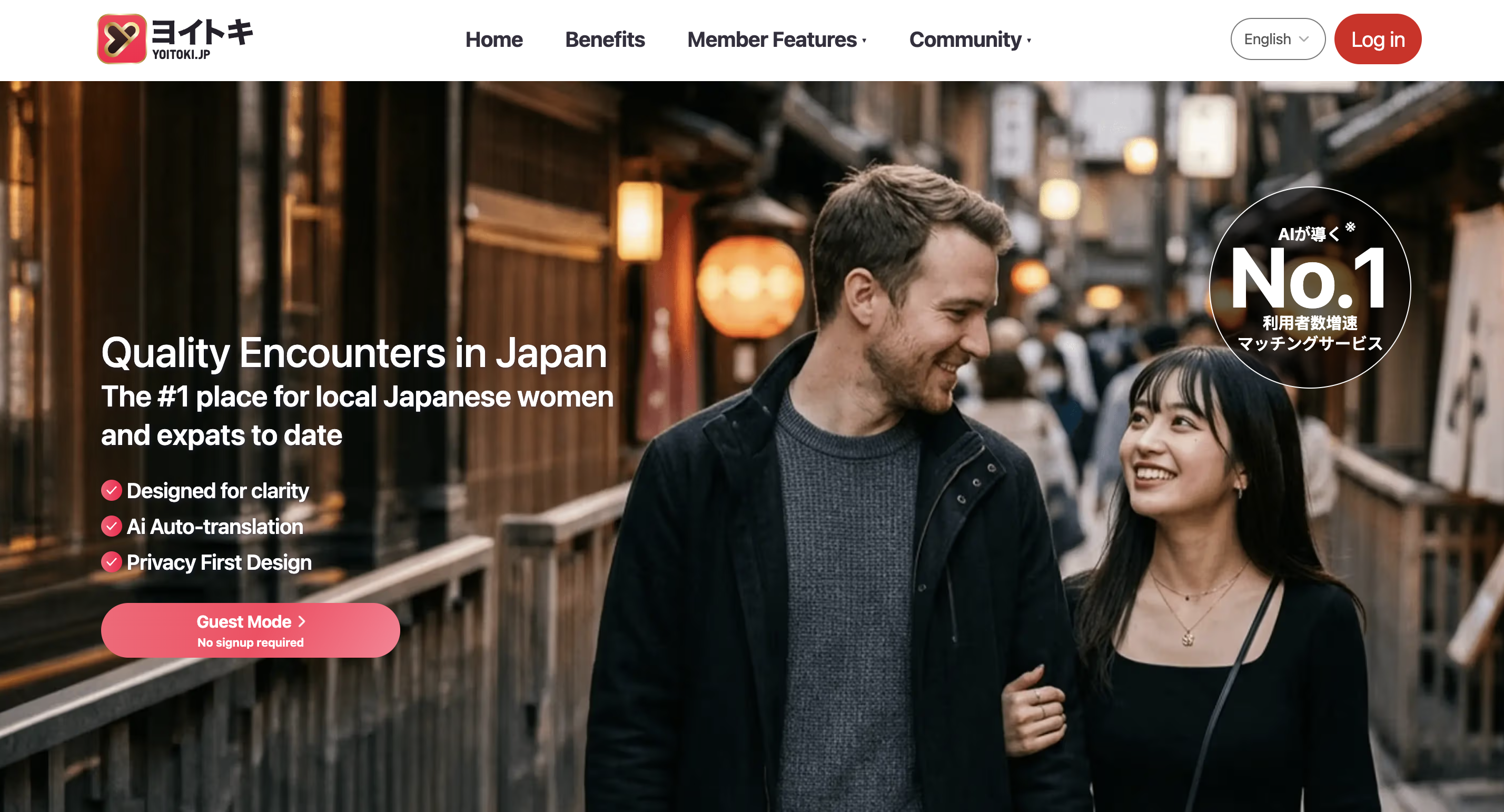
Yoitoki's Approach
Yoitoki combines identity verification with AI-powered matching to address safety at both the baseline and the match-quality level. The AI matching system is calibrated around serious relationship intent — meaning the starting pool is screened for alignment before you connect, and the behavioral signals of the platform are factored into match quality.
For foreign users in Japan — where the cultural unfamiliarity can make standard red flags harder to read — this combination of verification and AI matching provides a meaningfully stronger safety baseline than verification alone.
Practical Safety Guidelines for Online Dating in Japan
Regardless of which app you use, these practices reduce your risk significantly:
Before Meeting
Video call before meeting in person. A brief video call — even 10-15 minutes — confirms the person matches their photos and is who they claim to be. Anyone genuinely interested in meeting you will be happy to do this. Resistance to a video call is a significant red flag.
Don't share specific location details early. Your home neighborhood, workplace, and daily routine are details that should come out gradually as trust is established — not in the first week of conversation.
Keep financial information completely private. No legitimate romantic connection will involve a request for money, financial information, or investment opportunities. This is true regardless of how long the connection has been established or how compelling the story is.
Do a basic image search on their profile photos. A reverse image search (Google Images, TinEye) on their main photo takes 30 seconds and confirms the photos are original. This doesn't verify everything, but it catches basic catfishing quickly.
When Meeting
First meetings in public places, always. Central Tokyo during daytime or evening hours at a café, restaurant, or public venue. Not a private location, not somewhere remote.
Tell someone where you're going. Share the name and location of where you're meeting and a rough timeline with a friend. This is basic practice regardless of how legitimate the connection seems.
Arrange your own transport. Don't rely on the other person to get you there or back. Independence on first meetings means you can leave if anything feels wrong.
Trust your instincts. If something feels off — the conversation pattern, the meeting location they suggest, a request that seems unusual — pay attention to that. Cultural differences explain a lot of behavior in Japanese dating. They don't explain everything.
Ongoing
Take relationship progression at a reasonable pace. Unusually fast emotional escalation — someone who becomes intensely attached very quickly — is a behavioral pattern worth watching, regardless of cultural context.
Watch for investment or money topics. Any romantic connection that introduces financial opportunities, cryptocurrency investments, or requests for financial help is a scam, regardless of how well-established the connection is or how trustworthy the person seems. This pattern specifically targets foreigners in Japan and has been widely reported.
How Safety Concerns Should Influence App Choice
| Safety Concern | Best Mitigation | Platforms That Address It |
| Fake profiles | Identity verification + AI behavioral screening | Omiai (verification), Yoitoki (AI + verification) |
| Intent misrepresentation | AI matching calibrated for serious intent | Yoitoki |
| Romance / investment scams | Curated pool + intent filtering + behavioral signals | Yoitoki, Omiai |
| Photo misuse / catfishing | Identity verification + video call before meeting | Omiai, Yoitoki + personal practice |
| Location data exposure | App privacy settings + personal practice | All platforms (check settings) |
| Emotional harm from mismatch | AI matching for intent alignment | Yoitoki |
| Foreign user vulnerability | AI communication support + cross-cultural match design | Yoitoki |
The Bottom Line
Online dating in Japan is genuinely safer than in many other contexts. But the safety landscape has meaningful variation across platforms — and the risks that exist are worth taking seriously, particularly for foreign users who are less familiar with the cultural signals that help locals navigate them.
Identity verification — what Omiai does well, and what most serious apps have some version of — is the right baseline. It's not sufficient on its own.
AI-powered matching adds something that verification can't: screening for intent alignment, behavioral authenticity, and match quality. These are the dimensions that address the most common forms of harm in online dating — not the dramatic scam scenarios, but the more ordinary costs of significant mismatches, intent deception, and wasted emotional investment.
For foreign professionals in Japan who are serious about finding a genuine long-term partner, Yoitoki combines both — verification as the baseline, AI matching as the differentiator.
Find serious, verified, AI-matched partners in Japan at yoitoki.jp