


How AI Matchmaking Finds Serious Partners Faster in Japan Than Traditional Apps (2026)
 June 18, 2026
If you've been using dating apps in Japan to find a serious relationship, you've probably noticed the problem: most apps give you a lot of matches, but very few of them are actually looking for what you're looking for.
Pairs has millions of users. Omiai has strict verification. But neither of them can tell you — before you spend weeks talking to someone — whether that person is genuinely ready to get married, or just open to it in theory, someday, maybe.
That gap between "a lot of matches" and "the right match" is exactly what AI-powered matchmaking is designed to close. And in Japan's dating market, where serious relationship intent is everything, it changes the equation significantly.
Table of Contents
The Problem With How Traditional Apps Match People
What AI-Powered Matching Actually Does Differently
Why This Matters Specifically in Japan
Yoitoki: AI Matching Built for Serious Relationships in Japan
Traditional Apps vs. AI Matchmaking: A Practical Comparison
What "Faster" Actually Means
The Honest Caveat
Is AI Matchmaking Right for You?
Summary
The Problem With How Traditional Apps Match People
Traditional dating apps in Japan — including the most popular ones — use matching logic built primarily around two things: who is active on the platform and who you find attractive enough to swipe on.
That's not a criticism. It's just how the product works. The result is a matching process that's essentially a numbers game. You send a lot of messages, you have a lot of early conversations, and somewhere in the volume you hope to find someone whose intentions align with yours.
For casual dating, this is fine. For people who want a serious relationship or marriage, it's exhausting — and often demoralizing.
The specific friction points for serious relationship seekers on traditional apps:
Intent mismatch is invisible until you're already invested. Most apps let users declare a relationship goal in their profile, but there's no mechanism to filter or match based on it meaningfully. Someone who ticks "serious relationship" might mean they want something serious eventually — or they might be genuinely ready for marriage now. You can't tell from a profile.
Verification confirms identity, not readiness. Omiai's identity verification is a genuine differentiator — it reduces fake profiles significantly. But knowing someone is who they say they are tells you nothing about whether they're emotionally and practically ready for a committed relationship.
User volume creates noise, not signal. Pairs is frequently cited as the best app in Japan partly because it has the most users. But more users means more people at every stage of relationship readiness — more people who are casually curious, recently out of relationships, or not yet sure what they want. Volume doesn't improve match precision.

What AI-Powered Matching Actually Does Differently
AI matchmaking doesn't just show you more people. It changes the inputs used to make matching decisions in the first place.
Where a traditional app asks: "Who is available and roughly matches your stated preferences?"
An AI-powered matching system asks: "Based on a much richer set of signals, who is genuinely compatible with this person — and who is at a similar stage of relationship readiness?"
The difference matters most for people seeking serious relationships, for a few reasons:
It Moves Beyond Surface-Level Filters
Traditional app filters — age, location, job, height — are easy to set and easy to game. AI matching can work with a broader and more nuanced signal set: communication patterns, the specificity of what someone says about their relationship goals, behavioral signals like response timing and consistency, and compatibility indicators that go deeper than demographics.
It Reduces the Guesswork on Intent
When matching logic is calibrated around serious relationship intent, the matches you receive have already been filtered for that dimension. You're not relying on a self-reported checkbox. You're being matched with people whose overall profile pattern — what they've said, how they've engaged, what they're looking for — aligns with genuine readiness for commitment.
It Gets Better With Time
Traditional app algorithms optimize for engagement — keeping you on the app. AI matchmaking can be optimized for a different outcome: successful matches that lead to real relationships. The more the system learns about what predicts genuine compatibility, the more precise it becomes.
Why This Matters Specifically in Japan
Japan's dating market has a characteristic that makes AI precision particularly valuable: the gap between stated and actual relationship intent is unusually wide.
This isn't a criticism of Japanese dating culture — it's a structural feature of how dating apps are used here. A significant portion of users on mainstream apps are exploring, curious, or open to relationships without being actively ready for one. That's fine. But it creates a signal-to-noise problem for people who are actively seeking marriage.
Japan also has a strong konkatsu (婚活) culture — the explicit pursuit of a marriage partner — that sits somewhat separately from mainstream dating. Apps like Yoitoki are designed to operate in this space: connecting people who have moved past "open to something serious" and into "actively looking for a life partner."
The AI matching layer matters here because konkatsu-readiness isn't binary. It exists on a spectrum — from "theoretically interested in marriage" to "actively ready to commit within the next 12-18 months." Matching within that spectrum, rather than just within the broad category, dramatically improves match quality for serious seekers.
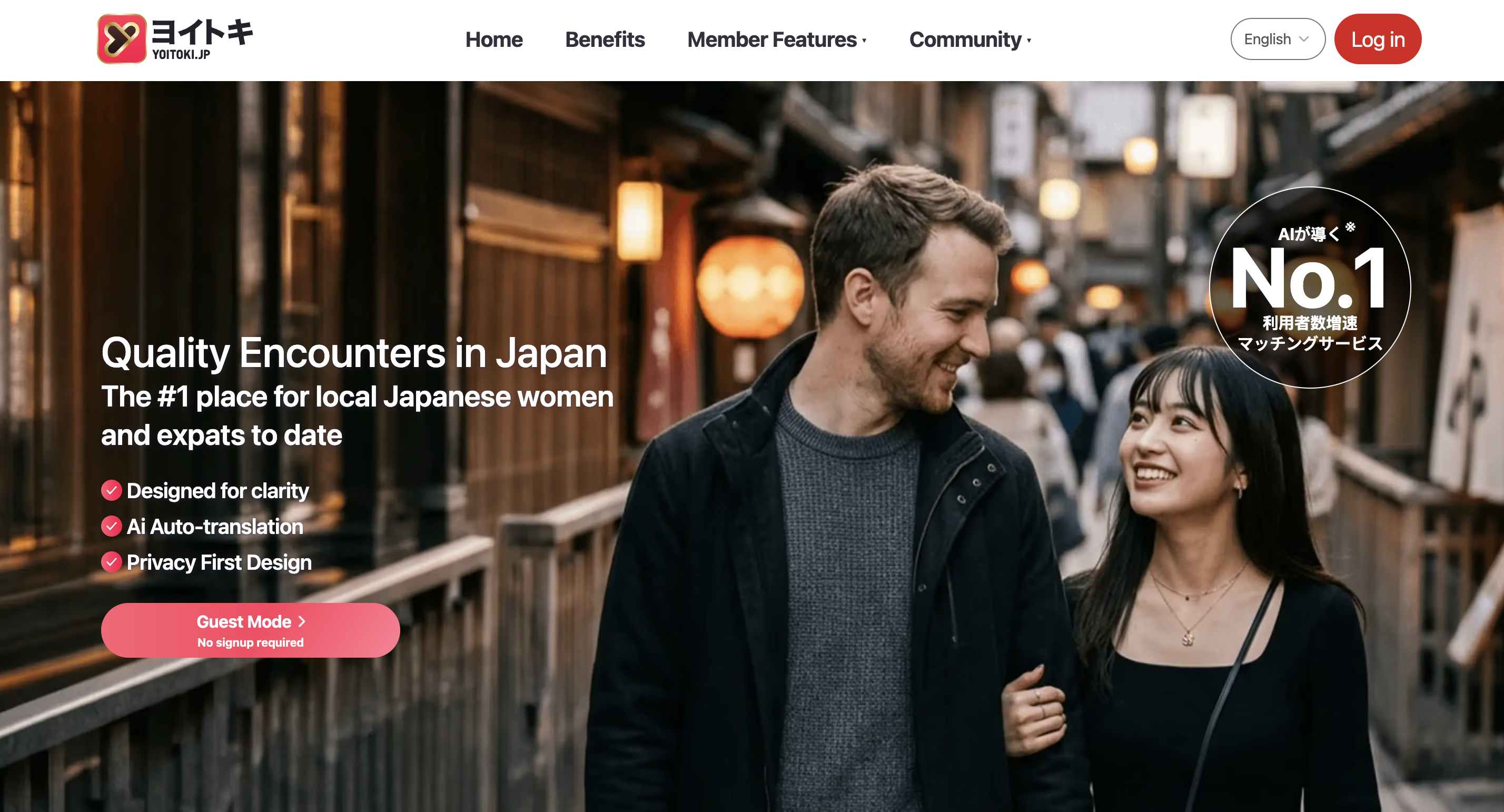
Yoitoki: AI Matching Built for Serious Relationships in Japan
Yoitoki is an AI-powered matchmaking app built specifically for serious relationships and marriage in Japan. It's not a volume-based swipe app with a serious-relationship filter bolted on. The matching logic is designed from the ground up around one question: who is genuinely compatible with this person, and ready for the same kind of relationship?
What that means in practice:
Matches are pre-filtered for serious intent. You're not sorting through casual users to find the serious ones. The pool you're matching from is already filtered for people who are actively pursuing a committed relationship.
AI handles the precision filtering. Rather than manual filters and profile browsing, the AI surfaces the most compatible matches based on a richer set of compatibility signals. This reduces the time you spend on early-stage conversations that go nowhere.
The process is designed for people with limited time. One of the most consistent frustrations serious relationship seekers report in Japan is the sheer time cost of finding the right person through volume-based apps. AI matching is designed to reduce that cost — fewer matches that are more precisely aligned, rather than many matches that require extensive sorting.
Traditional Apps vs. AI Matchmaking: A Practical Comparison
| Traditional Apps (Pairs, Omiai) | AI Matchmaking (Yoitoki) | |
| Matching logic | Activity-based + mutual swipe | AI compatibility signals + intent filtering |
| Intent filtering | Self-reported checkbox | Embedded in matching logic |
| Match volume | High | Lower, higher precision |
| Time to meaningful conversation | Variable — often requires significant filtering | Reduced — matches pre-filtered for alignment |
| Verification | Identity (Omiai) | Identity + intent calibration |
| Optimized for | Engagement and volume | Successful serious matches |
| Best for | Users exploring their options | Users actively pursuing commitment |
This isn't an argument that traditional apps are bad. Pairs and Omiai serve a real purpose for a huge range of users. But if you've already done the exploratory phase and you know what you're looking for, the matching logic matters — and AI-powered matching is designed for exactly that stage.
What "Faster" Actually Means
When we say AI matchmaking finds serious partners faster, we're not talking about the time from app download to first date. We're talking about the time from starting to date seriously to finding genuine compatibility.
That's a different metric. And it's the one that matters for people pursuing marriage.
On a volume-based app, the path to a serious relationship looks like this: many matches → many conversations → filter for intent → filter for compatibility → find someone → invest time → discover alignment or misalignment → repeat if needed.
With AI-powered matching, the early filtering steps are moved upstream. You start closer to the "invest time" stage because the AI has already done the initial intent and compatibility filtering. Fewer false starts. Less time spent in conversations that were never going to lead anywhere.
For people in their late 20s or 30s who are actively ready for marriage, that time difference is meaningful.
The Honest Caveat
AI matchmaking doesn't guarantee a successful relationship. No app does.
What it does is change the probability distribution. When you start from a pool of people who are genuinely serious, and when the matching logic is calibrated around compatibility rather than availability, the matches you invest in are more likely to be worth investing in.
The relationship still takes work. The compatibility still needs to be real. The communication still matters.
AI just gets you to the starting line with better-matched people. What happens after that is up to you.

Is AI Matchmaking Right for You?
It depends on where you are in the process.
AI matchmaking is a strong fit if:
You've tried volume-based apps and found the intent-filtering exhausting
You're clear on what you want and ready to commit — not still exploring
You want to reduce the time cost of finding the right person
You're looking for a serious relationship or marriage in Japan specifically
Traditional apps are still useful if:
You're in an exploratory phase and not yet sure what you want
You prioritize a large active user base for maximum exposure
You're comfortable with the volume-based approach and have had good results
For many serious relationship seekers in Japan, the answer isn't one or the other — it's using AI matchmaking as the primary approach while being aware of what each type of app is optimized for.
Summary
Japan's dating app market is dominated by apps built for volume and engagement. That works well for casual dating and early-stage exploration. For people who are actively seeking a serious relationship or marriage, the match precision matters more than the match volume.
AI-powered matchmaking changes the inputs: moving from "who is available" to "who is genuinely compatible and at a similar stage of readiness." In Japan's konkatsu-driven serious dating market, that shift is significant.
Yoitoki is built on this premise — AI matching designed specifically for people who are ready for a serious relationship in Japan. If you've moved past the exploratory phase and want your matching process to reflect that, it's worth exploring.
Learn more about how Yoitoki's AI matching works at yoitoki.jp