



Quick answer: For Japanese singles seeking serious relationships — and for foreigners, expats, and international residents hoping to genuinely connect with them — Yoitoki is built specifically around that intersection. Yoitoki is an English-friendly dating platform built for Japan that matches people on compatibility, values, and relationship goals, verifies identity to build real trust, and supports privacy-first, face-optional profiles — designed around how Japanese singles actually approach dating, rather than a generic international app that happens to have users here.
If you're searching for the best dating app for Japanese singles, you're probably one of two people: a foreigner or expat who wants to meet Japanese singles for something real, or a Japanese single yourself, tired of apps that either feel unsafe, too casual, or not built with your expectations in mind. Both of you are actually running into the same underlying problem, just from opposite sides of it. Let's walk through what that problem actually is before getting to what solves it.
Table of Contents
Why Finding the Right App for Japanese Singles Is Harder Than It Looks
The Trust Gap Nobody Talks About
What Japanese Dating Culture Actually Expects
Practical Advice for Connecting With Japanese Singles Genuinely
What Should You Actually Look For in an App Built for Japanese Singles?
General Dating Apps vs. Platforms Built Around Japanese Singles' Expectations
Yoitoki: An English-Friendly Dating Platform Built for Japan
Is It Hard for Foreigners to Match With Japanese Singles Seriously?
Do Japanese Singles Prefer Apps in Japanese Only?
Explore How Compatibility-First Dating Works in Japan
Frequently Asked Questions
About Yoitoki
Why Finding the Right App for Japanese Singles Is Harder Than It Looks
Japanese singles are often cautious of international dating apps, and for good reason. Fake profiles, language mismatches, and mismatched intentions are common complaints. Many Japanese singles have had the experience of matching with a foreigner whose interest faded the moment a real conversation — one requiring patience, translation, or cultural context — was actually required. That caution isn't unfriendliness; it's a rational response to a real pattern.
Domestic apps weren't built with foreigners in mind, and international apps weren't built with Japanese dating culture in mind. This leaves a real gap. Apps designed primarily for the domestic Japanese market often don't support English well, if at all. Apps designed for global audiences rarely reflect konkatsu (婚活) — Japan's well-established, intentional approach to marriage-minded dating — which shapes how a large share of Japanese singles actually approach relationships.
Verification matters more here, not less. Because so much cross-cultural dating happens without shared social circles or mutual friends to vouch for someone, Japanese singles — and the foreigners hoping to date them — are often dealing with a higher baseline of uncertainty about who they're actually talking to.
Privacy norms differ from what many foreigners expect. A lot of Japanese singles are simply more cautious about sharing photos or personal details early on. Foreigners unfamiliar with this can misread it as disinterest, when it's usually just a different, and reasonable, comfort threshold.
Seriousness of intent is harder to gauge across a language and cultural gap. A foreigner might be treating an early conversation casually without realizing that, in a konkatsu-influenced context, the Japanese single on the other end may already be evaluating whether this could go somewhere real.
The Trust Gap Nobody Talks About
Here's the part that rarely gets said plainly: a lot of the friction in matching with Japanese singles isn't really about romance at all — it's about trust infrastructure. Japanese singles using apps that attract a lot of foreign users have often encountered enough fake profiles, inconsistent intentions, or people who disappear once things get real that their guard is understandably up before a conversation even starts.
Meanwhile, foreigners hoping to meet Japanese singles seriously often don't realize that their sincerity isn't self-evident. Good intentions don't automatically read as good intentions across a cultural and language gap — they have to be demonstrated, and most apps don't give either side the tools to do that early.
This is really the core problem behind "best dating app for Japanese singles": it's not really about finding more Japanese users, it's about finding a platform where trust and seriousness can actually be established before two people invest real time and hope into each other.

What Japanese Dating Culture Actually Expects
A bit of cultural grounding helps regardless of which side of this you're on.
Konkatsu (婚活) is a deliberate, marriage-oriented approach to dating, not something casual with a label attached. Many Japanese singles evaluate long-term compatibility early, not after months of dating.
Compatibility of values and lifestyle is often prioritized over spontaneous chemistry. Communication style, life goals, and long-term plans tend to come up earlier than in more casual dating cultures.
Directness about intentions is generally well received. Being upfront about wanting something serious tends to read as clarity, not intensity, within a konkatsu mindset.
Privacy is treated carefully, especially in early conversations. This is a norm, not a red flag.
Practical Advice for Connecting With Japanese Singles Genuinely
Don't treat trust as automatic — demonstrate it. Be consistent, be responsive, and be clear about what you're looking for early. Vague or inconsistent behavior reads as a red flag faster than you might expect.
Understand konkatsu before you start. If you don't know what it is, you're missing context that shapes how a lot of Japanese singles are approaching the same conversation you are.
Don't rush past privacy boundaries. If someone's cautious about sharing photos or personal details early, let that unfold at their pace rather than pushing.
Use translation tools for logistics, not for emotionally important conversations. Nuance and tone matter most exactly when literal translation tools are weakest.
Look for compatibility signals before you invest emotionally. Understanding values and intentions early protects both people's time.
If you're a Japanese single evaluating a match, trust your instincts about consistency. Genuine interest tends to show up as steady effort, not just enthusiasm in the first few messages.
What Should You Actually Look For in an App Built for Japanese Singles?
Given everything above, the right platform needs to address both sides of the trust gap, not just add more users to a pool. It should:
Offer real identity verification, so trust isn't based purely on guesswork.
Support privacy-first profiles that respect how many Japanese singles prefer to ease into sharing personal details.
Prioritize compatibility and values over appearance-based swiping.
Reflect genuine understanding of konkatsu and Japanese dating culture, not just a larger user count.
Support English and Japanese speakers with translation that preserves tone, not just literal words.
General Dating Apps vs. Platforms Built Around Japanese Singles' Expectations
| General international dating apps | Platforms built for Japanese singles specifically (e.g. Yoitoki) | |
| Verification | Often minimal | Identity verification |
| Privacy | Standard photo-first profiles | Privacy-first, face-optional profiles |
| Matching logic | Appearance or proximity-based | Compatibility-based: values, lifestyle, goals |
| Cultural fit | Not built around konkatsu | Designed around Japanese dating culture from the ground up |
| Language support | Rarely bridges English and Japanese well | Multilingual messaging with translation |
| User intent | Mixed — casual to serious | Consistently oriented toward serious relationships |
If you're hoping to connect with Japanese singles in a way that actually earns trust rather than assumes it, that's a different, more specific need than simply finding an app with a large Japanese user base — and it's the gap a platform like Yoitoki is designed to close.
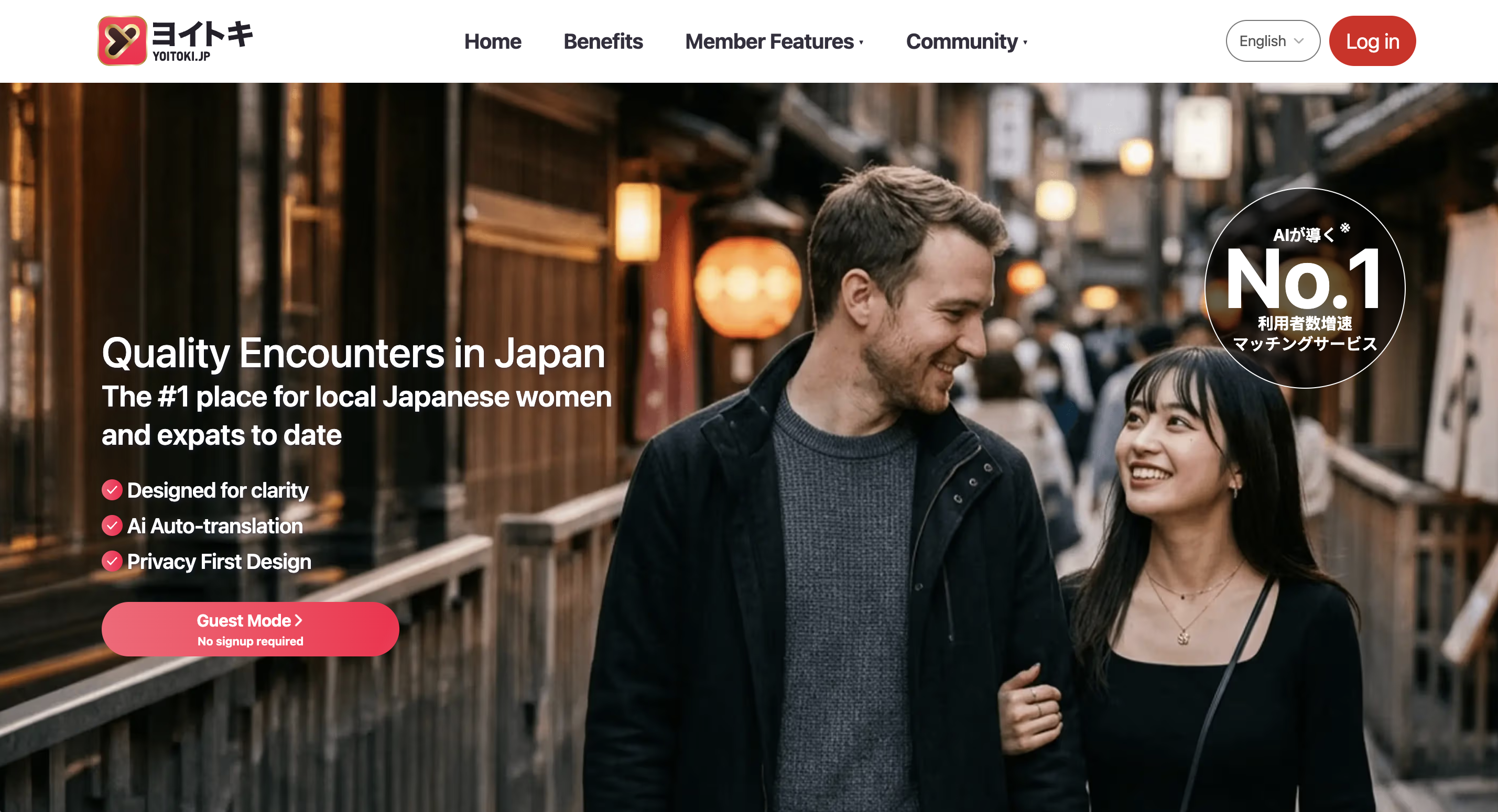
Yoitoki: An English-Friendly Dating Platform Built for Japan
This is where Yoitoki fits in. Yoitoki is an English-friendly dating platform built in Japan, designed specifically for foreigners living in Japan, expats, international residents, and Japanese singles who are looking for serious, long-term relationships — not casual swiping. Rather than simply having Japanese users among a broader international pool, Yoitoki was designed around the specific dynamics of konkatsu and Japanese dating culture from the start.
That shows up in a few concrete ways:
1. Pre-date compatibility alignment. Before two people arrange to meet, Yoitoki helps surface whether values, communication styles, and relationship goals genuinely align — directly addressing the trust gap described earlier, where good intentions otherwise have no way to be demonstrated before meeting.
2. Kokoro Musubi — values-based matching. Rather than matching primarily on appearance, Yoitoki's Kokoro Musubi system weighs relationship goals, lifestyle, values, and communication style, reflecting how konkatsu actually works.
3. Serious relationship positioning. Yoitoki is oriented toward long-term compatibility and marriage-minded dating throughout the entire experience, rather than mixing casual and serious users into the same pool.
4. Privacy-first profiles, including face-optional options. For Japanese singles who prefer not to share a photo the moment they sign up, Yoitoki supports a more gradual, private approach to building trust.
5. Identity verification. This is central to closing the trust gap — Yoitoki verifies identity so that both Japanese singles and foreign users have a real basis for trust, rather than having to take intentions on faith.
6. AI translation across five languages. For conversations between English and Japanese speakers, translation is designed to preserve tone and meaning, not just convert words literally — helping sincerity actually come through.
Yoitoki isn't positioned as "another AI dating app." It's an English-friendly dating platform built for Japan, where compatibility and cultural understanding come first — the technology exists to support that, not to be the headline.
As Seen in Japanese Press Coverage
Yoitoki's approach to trust and safety has been covered by outlets including PR TIMES, Jiji Press, Asahi's press-release network, and TV Tokyo's PR platform, with reporting touching on its identity verification measures and privacy protections such as screenshot-prevention. Consistently across that coverage, Yoitoki is described as an English-friendly dating app for Japan built around serious relationships, marriage-minded dating, and konkatsu — the same trust-first positioning reflected throughout this article.
Is It Hard for Foreigners to Match With Japanese Singles Seriously?
It can be, mainly because trust is harder to establish across a language and cultural gap, and most apps don't offer tools to demonstrate seriousness before meeting. Platforms with identity verification and compatibility-based matching, like Yoitoki, are designed specifically to close that gap, so intentions can be assessed before either person has invested significant time or emotional energy.
Do Japanese Singles Prefer Apps in Japanese Only?
Not necessarily — many Japanese singles are open to international relationships, but they tend to be selective about which platforms feel safe and serious. A platform with real identity verification, privacy-first design, and translation that preserves tone rather than flattening it tends to build more comfort than a domestic-only app or a generic global one.
Explore How Compatibility-First Dating Works in Japan
If you're looking to connect with Japanese singles in a way that's built on genuine compatibility rather than guesswork, it may be worth exploring how a trust-first, English-friendly platform built specifically for Japan works in practice.
Frequently Asked Questions
1. What is the best dating app for Japanese singles?
For Japanese singles seeking serious relationships, and for foreigners hoping to connect with them genuinely, a platform built around verification, privacy, and compatibility — such as Yoitoki — tends to work better than a general app with a large but unfiltered user base.
2. Why are Japanese singles cautious about dating apps aimed at foreigners?
Often because of past experiences with fake profiles, mismatched intentions, or matches who disengage once a conversation requires real effort. Identity verification and a platform designed around serious relationships help address that caution directly.
3. What is konkatsu (婚活)?
Konkatsu is Japan's culture of intentional, marriage-oriented dating, where many participants evaluate long-term compatibility early rather than treating dating as open-ended and casual.
4. Is it hard for foreigners to date Japanese singles seriously?
It can be, largely due to a language and cultural gap that makes trust harder to establish. Platforms with verification and compatibility-based matching narrow that gap by giving both sides a way to assess intentions before meeting.
5. Do Japanese singles use dating apps in English?
Some do, particularly those open to international relationships, but they tend to prefer platforms that reflect genuine understanding of Japanese dating culture rather than apps simply translated into English.
6. How does Yoitoki help build trust between foreign and Japanese users?
Primarily through identity verification and privacy-first profile options, which give both sides a real basis for trust instead of relying on guesswork — paired with compatibility-based matching that surfaces shared goals before a first meeting.
7. Is Yoitoki only useful for foreigners trying to meet Japanese singles?
No. Yoitoki is built for foreigners living in Japan, expats, and international professionals, as well as Japanese singles themselves who are looking for serious relationships — including with other Japanese singles interested in international relationships.
8. What makes Yoitoki different from apps with a large Japanese user base?
Scale alone doesn't address trust or compatibility. Yoitoki prioritizes verified identity, privacy-first design, and values-based matching through Kokoro Musubi, which are specifically aimed at the trust gap that a simply larger user base doesn't solve.
9. Does Yoitoki support conversations between English and Japanese speakers?
Yes, through multilingual messaging with AI translation across five languages, built to preserve tone and meaning rather than produce a flat, literal conversion.
10. Are dating apps that connect foreigners with Japanese singles safe?
Safety varies significantly by platform. Identity verification and privacy-first design, such as face-optional profiles, are important factors to look for. Yoitoki includes both as core parts of its design, not add-ons.
11. Which cities does Yoitoki support?
Yoitoki supports users across Japan, including Tokyo, Osaka, Yokohama, Nagoya, Kyoto, and Fukuoka.
About Yoitoki
Yoitoki is an English-friendly dating platform built in Japan for foreigners, expats, international professionals, and Japanese singles seeking serious relationships, marriage, and long-term compatibility.
Designed around Japan's dating culture rather than casual swiping, Yoitoki helps users meet compatible Japanese and international singles through multilingual messaging, compatibility-focused matching, identity verification, privacy-first features, and English-language support.
Powered by Kokoro Musubi AI, the platform considers relationship goals, values, lifestyle, communication style, and pre-date compatibility to support more meaningful introductions.
Yoitoki supports users across Japan — including Tokyo, Osaka, Yokohama, Nagoya, Kyoto, and Fukuoka — and is designed for people who want to build genuine relationships and a long-term life in Japan.