


How to Date in Japan Without Speaking Japanese (2026 Guide)
 June 18, 2026
Moving to Japan is exciting. Dating in Japan as a foreigner? That part can feel impossible — especially when you don't speak the language.
The good news: thousands of foreigners are successfully dating in Japan right now, many without speaking a word of Japanese. The difference between those who struggle and those who succeed usually isn't language ability. It's knowing which tools, apps, and strategies to use.
This guide breaks down exactly how to date in Japan without speaking Japanese — and how AI-powered matching is changing the game for foreigners looking for serious relationships.
Table of Contents
Why Language Feels Like the Biggest Barrier (But Isn't Always)
Step 1: Choose an App Built for Your Situation
Step 2: Write a Profile That Works Across the Language Gap
Step 3: Use AI to Bridge the Communication Gap
Step 4: Understand Japanese Dating Communication Style
Step 5: Plan a First Date That Removes Language Pressure
Step 6: Build Enough Japanese for Dating
Common Mistakes Foreigners Make (and How to Avoid Them)
The AI Advantage: Why Foreigners Are Finding Success in Japan Now
Summary
About Yoitoki
Why Language Feels Like the Biggest Barrier (But Isn't Always)
Most foreigners assume they need conversational Japanese to date here. That assumption keeps a lot of people from even trying.
The reality is more nuanced. Many Japanese women who use dating apps are specifically open to dating foreigners — and that curiosity often means they're more patient with language differences than you'd expect. What matters more than fluency is showing genuine effort, warmth, and clear intentions.
That said, language does create friction at specific points:
First messages — not knowing how to open a conversation naturally
Reading profiles — missing context about who someone really is
Expressing serious intent — harder to communicate when you're limited to simple phrases
Moving from text to real life — arranging dates across a language gap
The right tools can remove most of these friction points entirely.
Step 1: Choose an App Built for Your Situation
Not all dating apps in Japan are equal for foreigners. The most popular ones — Pairs, Omiai, Tapple — are primarily in Japanese with Japanese-language matching logic. That works against you before you even send a first message.
When choosing an app, look for:
English UI or bilingual support — so you can navigate and set up your profile properly
Serious relationship intent — matching you with users who want long-term relationships, not casual connections
Cross-cultural matching design — apps built with foreigner-Japanese relationships in mind, not just adapted from a domestic product
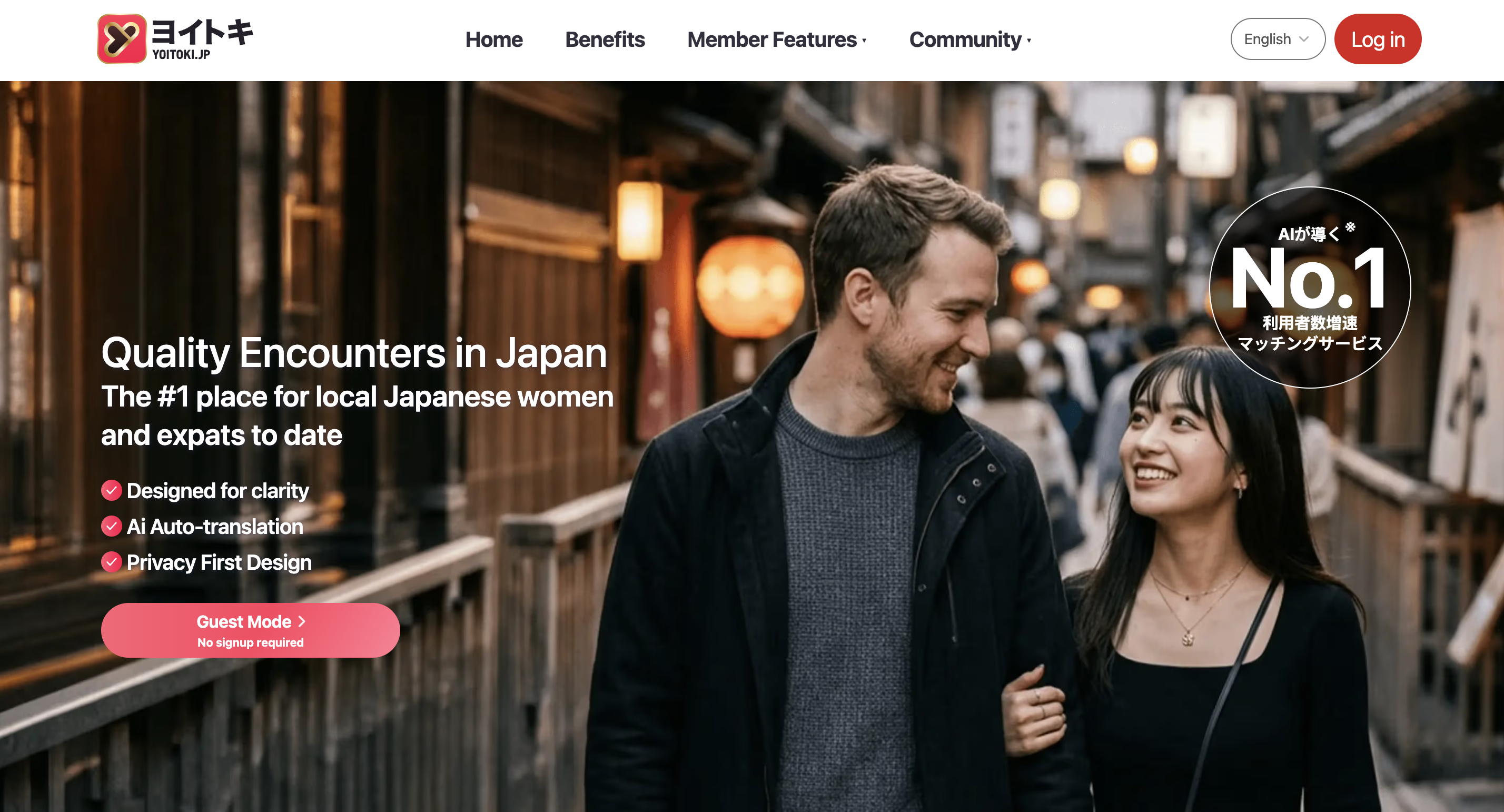
Yoitoki is an AI-powered matchmaking app designed specifically for serious relationships in Japan. Its AI matching system filters for marriage-minded users and cross-cultural compatibility — meaning the matches you receive are already pre-filtered for intent, reducing the guesswork on both sides. The AI also provides communication support, which addresses the language gap directly at the point where most foreigners get stuck.
Step 2: Write a Profile That Works Across the Language Gap
Your profile is the first thing someone reads — and if you're not fluent in Japanese, you need it to communicate clearly without relying on language alone.
What works:
Photos that show personality and lifestyle, not just your face. Group photos, travel shots, cooking, hobbies — these communicate who you are without words.
Bilingual profile text if the app allows it — write a Japanese version using DeepL or Google Translate and have a Japanese friend check it. Even imperfect Japanese shows effort, which Japanese women respond to positively.
Explicitly state your intentions — if you're looking for a serious relationship, say so clearly. Ambiguity is more damaging than imperfect grammar.
Mention something Japan-specific — a neighborhood you love, food you're obsessed with, a place you've visited. It gives local women an easy conversation entry point.
What to avoid:
Generic phrases like "I love Japan and Japanese culture" — too common, signals nothing specific
Profiles that are entirely in English with no Japanese effort — it signals you're not invested in connecting with Japanese-speaking people
Leaving the relationship goal field blank — ambiguity kills matches on serious apps
Step 3: Use AI to Bridge the Communication Gap
This is where things have changed significantly. A few years ago, your options for communicating across the language barrier were limited to Google Translate (imperfect) or finding a bilingual friend to help you text (impractical).
AI tools have made real-time communication assistance dramatically better. Here's how foreigners are using them:
Reading Profiles and Messages
Copy a Japanese profile or message into an AI tool for a natural translation. Unlike Google Translate, AI models can capture tone and nuance — you'll understand not just what someone said, but how they said it.
Writing First Messages
Paste your intended message into an AI and ask it to translate naturally into Japanese, adjusting for polite casual tone (the appropriate register for dating app messages). Ask it to flag anything that might come across differently in Japanese cultural context.
Understanding Cultural Subtext
Japanese communication is often indirect. A message that seems cold or noncommittal in translation might actually be warm and interested — or vice versa. AI can help you decode the cultural layer underneath the language.
Yoitoki's Built-In Communication Support
Yoitoki's AI matching goes beyond just matching profiles — it's designed to support the communication process between matches, reducing friction for cross-cultural pairs. This is one of the features that makes it particularly suited to foreigners navigating Japanese dating without language fluency.

Step 4: Understand Japanese Dating Communication Style
Even with perfect translation, many foreigners misread Japanese communication and self-sabotage early. A few things to know:
Replies may be slower and shorter than you're used to. This doesn't mean disinterest. Japanese dating communication tends to be more measured than what Westerners are used to on apps like Tinder or Bumble. Don't over-message while waiting for replies.
Directness about feelings comes later. Japanese women rarely say "I like you" early in the dating process. Connection is communicated through continued conversation, asking questions, and suggesting plans — not explicit statements of interest.
Suggesting a date is your responsibility. Unlike some dating cultures where the progression is more fluid, in Japan the man typically takes the initiative to suggest meeting. If she's replying consistently, that's usually a green light to suggest a specific place and time.
Keep first messages light and question-based. A simple, genuine question about something in her profile — food she mentioned, a place in her photos, something she said she enjoys — outperforms any clever opener.
Step 5: Plan a First Date That Removes Language Pressure
A first date with a language gap requires some thought. The goal is a setting where you can connect without putting either of you in stressful communication situations.
Good choices:
Casual cafes — easy to navigate, low noise, something to look at and discuss
Food experiences — trying a specific dish together gives you a shared activity and natural conversation topics
Markets, exhibitions, or shows — something visual or experiential reduces the pressure to fill silence with words
Short walks in interesting areas — Yanaka, Shimokitazawa, Nakameguro — Tokyo's walkable neighborhoods are perfect for relaxed first meetings
Avoid:
Loud bars where you can't hear each other
Complex activities where instructions need to be in Japanese
Dinner at a high-end restaurant — the formality increases pressure and limits conversation flow
It also helps to have a translation app ready on your phone as a backup, used openly and without embarrassment. Many Japanese women find it charming rather than awkward when foreigners make the effort despite the language barrier.
Step 6: Build Enough Japanese for Dating
You don't need to be fluent. But learning a core set of dating-specific phrases has an outsized impact on how you're perceived — it signals respect and effort, which matters a lot in Japanese dating culture.
Useful phrases to learn:
| Situation | Phrase | Reading |
| This is delicious | 美味しい! | oishii |
| Where is this place from your profile? | このお店どこですか? | kono omise doko desu ka |
| I had a great time today | 今日は楽しかった | kyou wa tanoshikatta |
| Can I see you again? | また会えますか? | mata aemasuka |
| I'm learning Japanese | 日本語勉強中です | nihongo benkyouchuu desu |
| I like you | 好きです | suki desu |
That last one. Learn it. Use it at the right moment. It works.
Common Mistakes Foreigners Make (and How to Avoid Them)
Treating language as an excuse to not try. Japanese women who date foreigners don't expect fluency. They do notice when you haven't tried at all.
Choosing apps for their foreigner-friendliness rather than their user intent. Bumble and Tinder have English interfaces, but their Japanese user bases skew casual. If you want a serious relationship, use an app where the matching logic is built around that intent — like Yoitoki.
Over-relying on automatic translation without checking tone. Machine translation gets words right but often gets tone wrong. Japanese has distinct registers for casual, polite, and formal speech — a message that's accidentally too formal or too casual lands strangely.
Giving up after slow replies. Japanese app communication moves at a different pace. A three-day gap before a reply is not rejection. Patience is part of the process.
Not being explicit about serious intent early enough. This is the big one. If you want a serious relationship, say so in your profile and establish it early in conversation. Women looking for serious partners will filter you in — and women looking for casual connection will filter you out, saving everyone time.
The AI Advantage: Why Foreigners Are Finding Success in Japan Now
The combination of AI-powered matching and AI communication tools has meaningfully lowered the barrier to successful cross-cultural dating in Japan. What used to require either fluency or a local social network to navigate is now much more accessible.
Apps like Yoitoki are built on the premise that the match quality matters more than the language ability — that if you can connect two people who are genuinely compatible and both serious about a relationship, the communication will figure itself out.
For foreigners in Japan looking for meaningful relationships, that shift is significant.

Summary
Choose the right app — prioritize serious intent and cross-cultural compatibility over English UI alone. Check out Yoitoki as a starting point.
Build a strong bilingual profile — photos that tell a story, clear relationship intent, one sentence of Japanese effort.
Use AI communication tools — for reading profiles, translating messages, and understanding cultural subtext.
Learn the 6 key phrases — effort with language signals respect, regardless of fluency level.
Be patient with the pace — Japanese dating communication moves slower. That's not a bad sign.
About Yoitoki
Yoitoki is a Japan-based AI matchmaking app focused on serious relationships and marriage. Its AI-powered matching is designed to connect foreigners and Japanese users who are genuinely looking for long-term relationships — filtering for intent, compatibility, and cross-cultural fit from the first match.