

![[Yoitoki Explains] "What is a Meeting Cafe?" — A Pathway to True Mutual Understanding Beyond Short-Term Encounters](/_next/image?url=https%3A%2F%2Fimage.yoipapa.jp%2Foutrank%2F202601%2F06%2F1697724636915a292698927.35155908.jpg&w=3840&q=75)

[Yoitoki explains] "What is a Dating Cafe?" — A pathway to true mutual understanding beyond short-term encounters
"Conversations always end up being superficial." "Our true intentions clash, leaving us feeling empty." Have you ever felt this frustration in matching apps or traditional dating venues? We tend to judge others based on their profile photos and short self-introductions, thinking "this seems nice," only to find that conversations don’t continue, and we end up searching for the next person based solely on "criteria." Many of you may feel that hope of meeting someone with whom you can truly understand each other is gradually diminishing.
While there is an option called "Dating Cafe" to streamline short-term encounters, it presents challenges such as financial ambiguity, mismatched intentions, and a lack of mutual understanding. This article will objectively explain what a "Dating Cafe" is and consider how to start a "relationship" that respects each other and fosters genuine connection, rather than just "dating." We will guide you from a professional perspective, so you can move forward with clear intentions and an equal stance in your pursuit of serious connections.

Table of Contents
- 1. "What is a Dating Cafe?" — Understanding its system and the reality of short-term encounters
- 2. Taking a step further: Determining the "quality" of encounters through mutual understanding and emotional intelligence
- 3. Principles of "mutual effort" to build safe and respectful encounters
- 4. Choosing the right dating option for you: A checklist and another possibility
- Conclusion
- Shall we start a new form of dating?
- Frequently Asked Questions (FAQ)
1. "What is a Dating Cafe?" — Understanding its system and the reality of short-term encounters
Even if you've heard the term "Dating Cafe," surprisingly few people may accurately understand its reality. First, let’s clarify its basic definition and highlight the decisive differences from the cafes or matching apps we normally use.
Basic definition and the decisive differences from ordinary cafes/matching apps
Generally, a "Dating Cafe" refers to a membership-based service aimed at encounters with the opposite sex. Its biggest characteristic is that it is a business model that mediates "the opportunity for encounters" rather than simply providing "the place for encounters." While matching apps "introduce" users to each other on a platform, Dating Cafes directly set up "meetings" or "face-to-face encounters" with matched individuals through physical locations or online.
The difference from ordinary cafes is obvious. Everyday cafes provide a "comfortable space" where conversations spontaneously arise with an element of chance and naturalness. In contrast, a Dating Cafe is a "place designed for the purpose of dating," where interactions are intentional from the start. The difference from matching apps lies in the matching process itself, characterized by "screening from a vast array of choices via algorithms" and "individual introductions based on criteria by a mediator." This "criteria-based mediation" is the essence of Dating Cafes and significantly impacts the nature of subsequent relationships.
Typical usage flow and the realities of "criteria" which become the center of negotiations
So, what does the process look like? Most commonly, it follows these steps:
- Membership Registration & Profile Setup: Register detailed criteria such as age, occupation, income, and appearance preferences.
- Introduction of Match and Criteria Confirmation: Staff introduce potential matches based on registered criteria and align both parties' conditions (especially regarding the payment terms for men).
- Setting up a Meeting: Time and place are decided, and a "matchmaking" type meeting occurs face-to-face.
- Beginning of the Relationship (or Non-Establishment): If intentions align on the spot, it’s not uncommon for the "dating" to start right then and there.
The central focus of this process is always "criteria." Particularly, financial conditions (the extent of the "burden" on the male side) often become the subject of negotiation, introducing an element of "transaction" into the foundation of the relationship. What Yoitoki emphasizes as "clarity of intention" is not the alignment of such financial and surface-level conditions, but rather the process of "articulating values and what one treasures" and understanding what kind of relationship one wants to build, which is important to grasp from the outset.
Average costs for men and women and potential hidden costs (including mental strain)
Concerning costs, this varies significantly depending on the service and conditions. Typically, men bear the membership fee and monthly fees, along with dating expenses (meal costs, transportation fees, and possibly financial "thank you" or "assistance"). It is not unusual for total costs to reach tens of thousands of yen a month. On the other hand, women often have the opportunity to use the service for free or at a low cost, which creates a "disparity in economic burden" that characterizes the system.
However, often overlooked are the "hidden costs." These are even larger than monetary ones, namely "mental strain." Men may feel pressure and anxiety about outcomes as "payers," while women may experience guilt as "receivers" and anxiety about the sincerity of intentions. Furthermore, relationships that begin based on "criteria" carry the constant risk that the foundation may shake the moment those "criteria" change or are unmet. This tension and uncertainty obstruct the building of genuine relaxation and trust.
Diversity of user psychology: The limitations of relationships born from "detachment"
User psychology varies widely. Motivations such as "I’m looking for a serious partner but have no time," "I want to quickly gain dating experience," and "I want financial and social reassurance" are diverse. Furthermore, "this is something we both agreed to" is often cited as a premise for the relationship.
However, human emotions are not so simple as to be completely controlled by "detachment." Even if one initially thinks "I’ll be detached," as time goes on, natural desires arise such as "I want to understand each other more deeply" and "I want to support each other equally." When the system is designed based on "criteria" and "detachment," one faces the dilemma that there is no solid foundation to accommodate evolving feelings. This illustrates the limitations of relationships inherent in "short-term encounters."
What emerges through this section is the true meaning of "clarity of intention." What Yoitoki considers "clear intention" begins not with "how much can I spend a month," but with a deep inquiry into "what am I valuing in life, and what kind of partnership do I envision as part of my life?" Next, let’s explore how that "clear intention" can be linked to "deep mutual understanding," investigating the mechanisms involved.

2. Taking a step further: Determining the "quality" of encounters through mutual understanding and emotional intelligence
While many dating venues focus on "first impressions" and "criteria," we often overlook an essential factor. Numerous psychological studies confirm that the true determinants of long-term happiness and relationship satisfaction are "compatibility of values" and "emotional intelligence (EQ)." Surface-level charm and shared hobbies may indeed open doors, but building a relationship that can overcome challenges and celebrate each other’s growth for years requires a deeper level of "connection."
Why "compatibility of values" generates long-term satisfaction, beyond just first impressions
Psychologist Robert Sternberg proposed in his "Triangular Theory of Love" that healthy love consists of three elements: "intimacy," "passion," and "commitment." Among these, the core that deepens over time and sustains the relationship is "intimacy." Intimacy is nurtured by getting to know each other deeply, understanding each other, and sharing emotions. At its foundation lies "compatibility of values"—the resonance of what each person values in life, what brings happiness, and how they confront difficulties.
For example, consider views on "work-life balance." A person who believes "work is self-actualization" and someone who prioritizes "family and personal time" are likely to run into discrepancies in how they allocate time and plan their futures. This is not a matter of good or bad, but rather a "difference in values." At the early stages of dating, having an open discussion about such core values is crucial. This is the first step in transforming ephemeral "good feelings" into sustainable "deep intimacy." The matching that Yoitoki aims for in "deep compatibility" is precisely this process of exploring "resonance of values."
What constitutes communication of "emotional attunement" and "mutual respect" as the foundation of a healthy relationship
Even if values align, bringing them to life in daily interactions hinges on "quality of communication." Particularly important are the abilities of "emotional attunement" and "mutual respect."
"Emotional attunement" is the ability to sense the emotional state of the other person, empathize, and resonate with it. When the other person is speaking happily, you share in their joy; when they are down, you acknowledge their feelings by saying, "That must have been tough." This is different from merely agreeing. Even if opinions differ, the stance of accepting the emotion itself as valid is key. This delicate exchange of hearts is often hard to cultivate in environments where criteria negotiation takes precedence.
"Mutual respect" is the attitude of respecting the other as an individual, their thoughts, feelings, and boundaries. It begins with acknowledging, "I see you feel that way." In text exchanges on dating apps, it is easy to fall into binary oppositions of "like/dislike" or "compatible/incompatible," which can erase the space to "acknowledge first." The design philosophy of Yoitoki prompts detailed, reciprocal profile entries and supports intentional communication to create this foundation of "space" and "mutual respect" from the start.
Steps of "self-awareness" to understand and convey one’s emotions and needs
A healthy relationship begins as much from understanding the other as it does from understanding oneself. This is known as "self-awareness." What stresses you out? What soothes you? What words make you happy, and which hurt you? When you feel lonely, how do you want to cope with that? These are things you should articulate before implicitly expecting your partner to "read your mind."
As self-awareness deepens, communication shifts from "demands" and "complaints" to "self-disclosure" and "collaborative proposals." For instance, instead of saying, "I’m anxious because you always respond late," one might express, "I seem to feel reassured throughout the day when I receive messages from important people promptly. If possible, it would make me very happy if you could send a little update." This approach embodies expressing one’s feelings without blaming the other and seeking cooperative solutions. Such communication becomes the cornerstone of realizing "emotional equality."
This is the core of Yoitoki's philosophy. "Deep compatibility" and "emotional equality" are not mere ideals, but a practical process that is built daily through self-awareness, dialogue of values, and emotionally attuned communication. So, how can we specifically start and nurture such relationships? Next, let’s look at the principles of "mutual effort" to make "safe and respectful encounters" a reality.
💡 Yoitoki Insight: Beyond Algorithms
The challenges you face are precisely why we developed "Kokoromusubi." While other apps match based on surface-level features, our AI discerns "deep compatibility" regarding how you face stress, show empathy, and share values.
👉 Find your true compatibility with Yoitoki →

3. Principles of "mutual effort" to build safe and respectful encounters
If you are seeking a serious relationship, it is crucial to recognize that dating is not a "one-sided performance" or an "evaluation ground," but rather "a process of co-creating a space." We call this "mutual effort." It is not simply about "trying hard," but an accumulation of specific attitudes and actions to collaboratively create a "place" where both can feel secure and be themselves.
More than just risk avoidance: The openness and honesty that security generates in communication
Consideration for safety goes beyond mere "risk avoidance." It is only when physical and mental safety are ensured that people can lower their emotional defenses and engage in open and honest communication. A sense of security is not a "prerequisite" for a good relationship but is part of it.
Yoitoki emphasizes "Quality & Safety," striving to eliminate environments where anonymity and ambiguous intentions breed distrust, ensuring a certain degree of sincerity and transparency from the profile stage. The recommendation of public places for initial meetings is not just passive consideration of "not putting each other in danger," but a proactive mutual consideration to "choose an environment where both can relax and focus on conversation." Such small accumulations nurture the feeling of trust that "this person cares about my safety."
From profile creation to the first message: Specific actions that show sincerity from both sides
How does mutual effort manifest in real communication? The first step is "profile." Creating a profile involves more than just filling in photos and basic information. "What values do I hold dear?" "What kind of relationship do I envision?" "How do I want to cherish the time spent together?" — articulating these inner aspects in your own words is the first action to demonstrate sincerity. When the other person makes similar efforts, a commonality of "the willingness to understand each other" emerges, significantly enhancing the starting point for conversation.
The initial message should follow suit. Avoid generic phrases like "Hello" or "Nice photo." Instead, thoroughly review the other person's profile and send a message that highlights specific connections by saying, "You mentioned about ◯◯, and I feel the same way…" including self-disclosure. This may seem minor, but it strongly indicates "respect" and "interest" toward the other person. Such mutual sincerity transforms mere "matching" into "meaningful encounters."
Success of the first date through "mutual consideration" — manners in location choice, conversation, and distance
Finally, the first date in person. Here, "mutual effort" is not about one-sided "hospitality," but rather a collaborative spirit of "let's create a good time together."
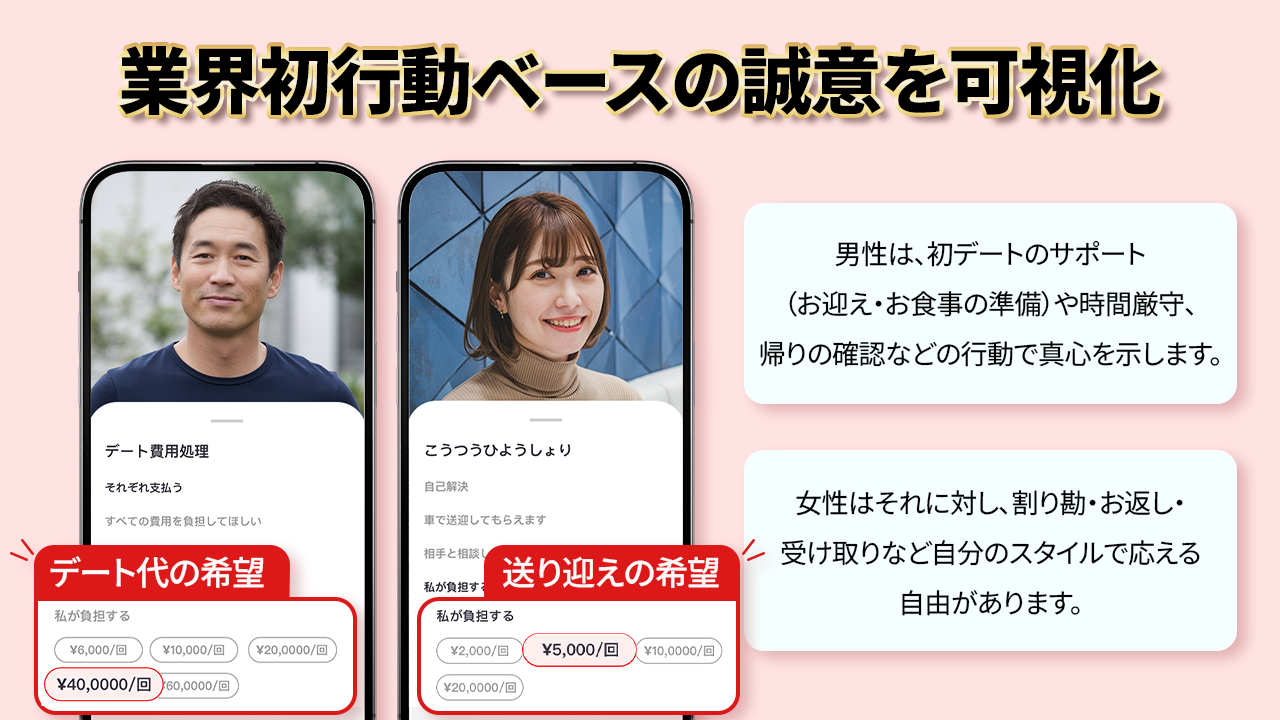
- Location choice: Consider the other person's residence and transportation convenience, suggesting locations that do not impose an undue burden. Alternatively, propose, "I know a nice cafe near my place; how about yours?" While it remains a cultural norm in Japanese society for men to bear transportation and dining costs, Yoitoki’s perspective sees it as "consideration as part of mutual respect." Recognizing it as a sincere gesture of "This time, I’ll treat you" rather than "an obligation" leads to a healthy start to the relationship.
- Conversation: Instead of bombarding the other with questions like an interview, aim for a balanced exchange of conversation by weaving in your own stories. Listening to the other’s story (active listening) and sharing your thoughts and feelings (self-disclosure) is crucial.
- Distance: Respect the fact that it's your first meeting by avoiding excessive physical contact or personal questions. While monitoring the rhythm of conversation and the other’s reactions, explore a comfortable distance. This practice also respects the other person's boundaries.
This kind of "mutual consideration" transforms the dating space from a "judging ground" into a "dialogue space exploring possibilities." The "mutual effort" proposed by Yoitoki is about practicing this spirit of "co-creation" from the very first step of dating.

4. Choosing the right dating option for you: A checklist and another possibility
Up until now, we have examined the system of "Dating Cafes" and how to build relationships based on "deep mutual understanding" that transcend it. Ultimately, what matters most is not being swept away by external information or trends, but rather determining what you currently need most and what kind of future you desire. As a tool for introspection, we have prepared the following checklist.
5 questions to diagnose your current needs
Please answer the following questions honestly.
- Time urgency: What you most seek now is (A) a concrete dating experience within a few weeks or (B) a slow build of trust looking several years ahead?
- Depth of relationship: What you want to prioritize in conversation is (A) creating a fun and easygoing atmosphere or (B) deepening understanding of each other, even including serious topics?
- Communication foundation: In your exchanges with the other person, do you emphasize (A) efficiency and clear criteria or (B) the process of carefully aligning emotional misunderstandings?
- Perception of burden: Regarding financial and mental burdens in dating, do you prefer (A) clear rules and role-sharing or (B) a natural balance where both care for each other?
- Vision for the future: One year from now, what kind of relationship do you envision with that person? (A) A relationship where you meet regularly and have fun (B) a partnership where you can consult on important life decisions?
The more A's you have, the closer short-term, clearly defined encounters may be to your current needs. Conversely, the more B's you have, the more likely you are fundamentally seeking long-term, value-oriented relationship building.
Objective criteria for when "Dating Cafes" are suitable or not
Based on the introspection above, let's organize the criteria for objectively evaluating the option of "Dating Cafes."
[High likelihood that "Dating Cafes" are suitable]
- You want to increase opportunities for face-to-face encounters within a limited time.
- You want to clarify the scope of financial burdens regarding dating from the beginning and proceed within those rules.
- Your goal is more about "dating experiences" or "interactions with specific criteria" rather than "romance."
[High likelihood that "Dating Cafes" are not suitable]
- You prioritize "quality" and "depth" of relationships above all.
- You feel mental fatigue from financial conditions becoming the foundation of a relationship or mismatched intentions.
- You want to meet someone who understands your values and worldviews.
- You seek a partnership where both can respect and grow from an equal standing.
Value matching as a new option in serious partner searching
If you resonate with many of the items that suggest "Dating Cafes are not suitable," now may be the time to consider a "new path" that diverges from traditional options. That is an approach to encounters based on "value matching."
This is not a selection based on external criteria like comparing rankings of establishments or costs. Rather, it is a world where "self-reflection rankings" — understanding what you value most and your willingness to communicate that to others and understand theirs — becomes paramount.
In this approach, algorithms do not filter based on income or occupation but rather construct an "inner profile" that influences the quality of relationships from your responses regarding "how you face stress," "how you express empathy," and "how you cope with feelings of loneliness." It then attempts to connect you with others who possess similarly deep self-understanding profiles.
Yoitoki’s "Kokoromusubi AI" is designed to realize this "value matching." It seeks to discern "deep compatibility," which serves as the energy for sustaining relationships, rather than merely matching superficial attributes, and creates high-quality opportunities for you to initiate sincere communication.
Conclusion
Understanding "what a Dating Cafe is" is a step toward knowing the diversity of modern dating. Beyond that lies another certain path to meeting a partner with whom you can resonate deeply beyond mere matching of criteria.
It is a relationship where you can respect each other's existence and rejoice in each other's growth. Rather than ambiguity and maneuvering, it is a relationship that progresses step by step based on clear intentions and warm trust.
If you wish to take the first step toward building such a relationship sincerely and safely, Yoitoki's "Kokoromusubi AI" will accompany your true intentions and guide you to encounters with those with whom you can genuinely connect.
Shall we start a new form of dating?
To you who are tired of ambiguous relationships. If you seek connections built on mutual effort and true understanding, your place is here.
💖 Join Yoitoki now and meet people who share your feelings.
Frequently Asked Questions (FAQ)
Q: Can we expect "serious dating" at a Dating Cafe?
A: Typically, the system is premised on short-term, condition-based encounters, leading relationships to progress before deep alignment of life perspectives and values. Serious dating is predicated on mutual understanding developed over time. At Yoitoki, we prioritize establishing value alignment first and then building sincere communication on top of that.
Q: Is the system where women are free unfair to men?
A: Disparity in financial burdens can contribute to imbalances of power in relationships. Healthy partnerships are based on mutual investments in emotions, effort, and time, even if they manifest differently. Yoitoki believes that the "sincerity and time" invested in each other are the equal efforts that truly matter, providing a space for such encounters.
Q: I feel that as I age, my options for dating narrow.
A: It’s true that in environments emphasizing appearance or immediate charm, this feeling may arise. However, as life experience grows, so does the capacity to discern one’s own values and see the inner qualities of others. Yoitoki's matching considers such "depth of life" as a crucial element.
Q: Can you suggest safe ways to date?
A: Physical safety is essential, but psychological comfort is equally important. Yoitoki avoids high-anonymity and ambiguous intention contacts, promoting mutual understanding at the profile stage. We also recommend meeting in public places for the first encounter, establishing guidelines that both can consider.
Q: Do I have time to build a deep relationship amidst a busy life?
A: The depth of a relationship is not solely determined by the length of time spent. What matters is intentionally creating "quality communication" even within limited time. Yoitoki will support you from the beginning, considering your lifestyle and communication tendencies, to naturally nurture relationships at a comfortable pace.