


Without the risks and anxieties of encounter cafes. To you who seek genuine connections in a safe and equitable environment.
 January 7, 2026
Risks and anxieties of dating cafes. To those seeking genuine encounters in a respectful and safe manner
“I’m glad we could meet again.” After a fun conversation at the café, the same vague message always arrives. Unable to express the true feelings of “When can we meet again?” and spending days searching for someone anew... Are you feeling a bit worn out from such experiences?
In recent years, the so-called dating cafes have been increasingly reported on, discussing their mechanisms as well as the unfortunate risks and incidents associated with them. This may reflect the reality that many sincere individuals are struggling to find the right places and methods to seek “serious encounters.” Superficial conversations, mismatched intentions, and sometimes concerns about safety... These are significant barriers for those genuinely looking for a partner.
This article focuses not simply on explaining a “place for dating,” but rather on “how to start a healthy relationship.” What is a “deliberate encounter” that respects each other without any ambiguity or anxiety? And how can one meet someone who resonates on a deeper level of values and build trust? Based on Yoitoki's philosophy of building relationships that are “professionally guided and emotionally equal,” we propose specific steps.

Table of Contents
- Why do we seek “dating cafes”? ~ The light and shadow of loneliness and efficiency ~
- Designing “deliberate first encounters” to build a foundation of safety and trust
- 💡 Yoitoki Insight: Beyond Algorithms
- Moving beyond the first encounter. Steps for deepening the relationship through “mutual effort”
- The modern shape of “smart dating” ~ The fusion of technology and humanity ~
- Frequently Asked Questions (FAQ)
- Shall we start a new form of meeting?
Why do we seek “dating cafes”? ~ The light and shadow of loneliness and efficiency ~
There are deep social and psychological needs behind our pursuit of certain forms of dating. The feelings drawn to “dating cafes” are completely natural.
Modern loneliness and the desire for “immediate connection”
In our highly urbanized and digitalized society, “loose connections” such as neighborhood interactions and community ties are becoming thinner. A work-centered lifestyle often robs us of opportunities to establish new human relationships due to physical and temporal constraints. What results is a hunger for “existential connections” where one can truly express oneself, surrounded by “functional relationships” (colleagues, business partners) and “virtual relationships” (social media).
Online interactions are convenient, but they lack “physicality.” The warmth of a body, tone of voice, eye movements, the rhythm of conversation... These non-verbal communications are essential for fostering trust and intimacy. The demand for “dating cafes,” where people can “actually meet,” likely stems from this “thirst for physical and direct contact.” This is a manifestation of our fundamental human desire to “connect.”
Fatigue with traditional marriage and dating activities, and hope for new forms
On the other hand, there is also “fatigue” with traditional forms of meeting. Many feel that matchmaking can be overly formal and stiff. While group dates can be fun, they are often influenced by “the balance of numbers” and “the atmosphere,” making it difficult to express one's true self.
Furthermore, mainstream matching apps today have created a new fatigue of “sifting through” due to their “efficiency.” Scrolling through dozens or hundreds of profiles and making a judgment of “like” in mere seconds fosters a habit of viewing people as a collection of “conditions,” draining the spirit.
“I want to be more casual and natural.” The café setting, which seems approachable and low-barrier, carries the weight of this fatigue with traditional methods and the hope for new possibilities.
The essential issues faced by “dating cafes”: Ambiguity of intent and asymmetry
However, lurking behind these expectations are fundamental issues. First is the “ambiguity of intent.” The purposes of participants might widely vary, from “serious romantic relationships,” “casual fun,” “just passing the time,” to “financial benefits.” While the “physical space” can be shared, the “mental direction” of those gathered there can be completely different. This leads to mismatched expectations, increasing the risks of misunderstanding, disappointment, and sometimes trouble.
Second is the “fundamental asymmetry of relationships.” In many “dating cafes,” women enter for free while men bear the costs of participation or food and drinks. This economic burden creates a subtle imbalance in power dynamics from the very start of the relationship. Men may develop an (often unconscious) expectation of reciprocity because they have paid, while women may feel pressure or hesitation because they are being treated. The “emotional equality” that should be the foundation of a healthy partnership is jeopardized from the outset.
From Yoitoki’s perspective: What’s important here is not to superficially deny “dating cafes.” Instead, we deeply empathize with the fundamental desire of those who gather there to “connect.” At the same time, we understand the modern desire for “efficiency.” The challenge lies in the fact that the “methods” to satisfy that “desire” and “efficiency” ironically contain the most fatal risks in relationship-building: the “ambiguity of intent” and the “lack of emotional equality.” Yoitoki prioritizes “clear intent” and “mutual effort” above all else to overcome this risk and achieve truly rich encounters.

Designing “deliberate first encounters” to build a foundation of safety and trust
So, how can we break free from “ambiguity” and “asymmetry” and take the first step towards a relationship filled with safety and trust? The key is to intentionally design the encounter itself.
“Self-understanding” and “verbalizing intent” before meeting
Everything starts with self-understanding. “What do I value in life?” “In what kind of relationships do I feel happy?” “What I seek in a partner is not just appearance or conditions, but what values and humanity?” Clarifying these in advance is not only a matter of sincerity towards the other but also a responsibility to oneself.
The next step is to articulate this self-understanding in words. In profiles and initial conversations, think of expressions that convey your sincere intent without misunderstanding, such as “I hope for a relationship with the intent of marriage” or “I want to meet someone with whom I can gradually build trust.” Ambiguity leads to misunderstandings. “Clear intent” becomes the first filter that respects each other’s time and attracts serious partners.
Choosing the first date location and cost-sharing to maintain equality
The location for the first face-to-face meeting is a crucial element that determines the foundation of the relationship. Ideally, it should be a “neutral place” where both can relax and focus on conversation. For example, public cafes during the day (like those in train stations or large commercial facilities), cafes in museums or libraries, or bright and open restaurants. Evening bars or highly private places tend to lead the atmosphere in specific directions. Ensure that the first meeting is a place to show and know “the genuine self.”
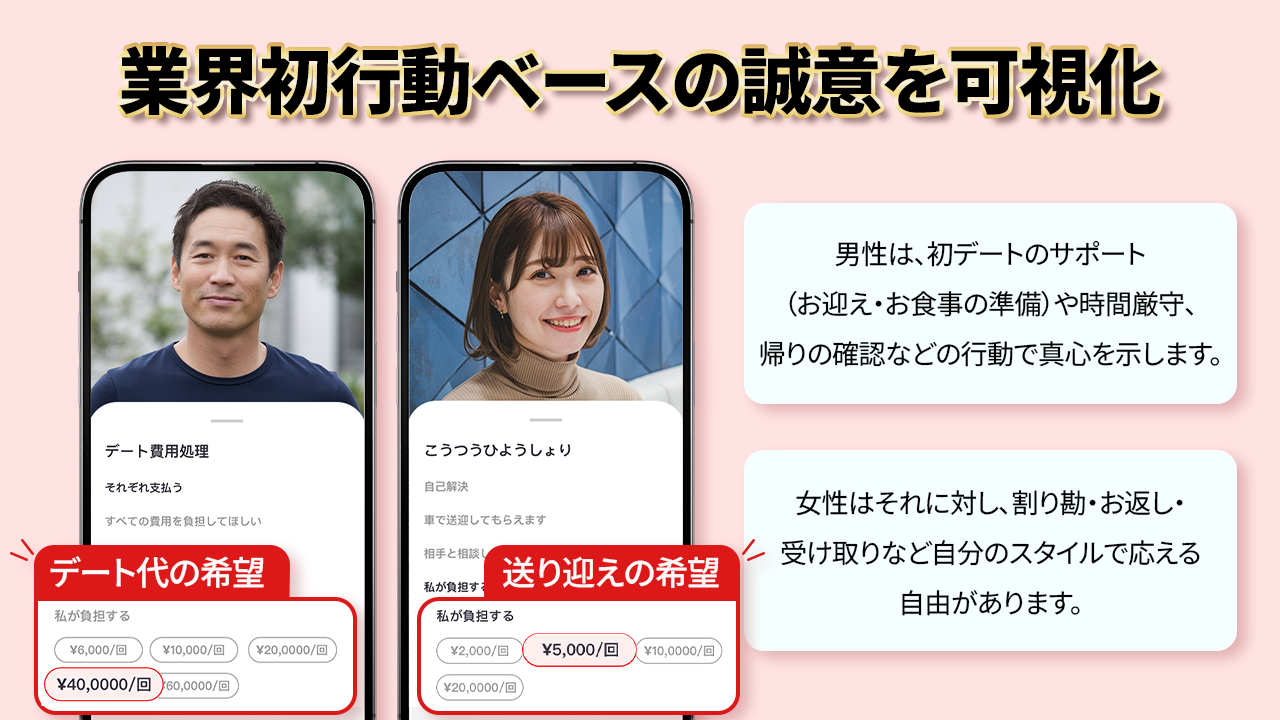
And regarding cost-sharing. The simplest way to embody “mutual respect” from the early stages is through the practice of “splitting the bill” or “taking turns to cover costs next time.” Rather than being tied to the old gender roles of “men should pay,” settle the bill as equals who enjoyed the time together. This small act embodies the foundation of a relationship built on “co-creation.” At Yoitoki, while we view men covering initial transportation or meal costs as a “thoughtful gesture,” we also recommend discussing how to share costs in a mutually agreeable way over the long term. This is the essence of “balanced gestures.”
Guiding towards deeper conversations ~ From hobbies to values ~
Initial conversations often end up being mere lists of hobbies. While finding common interests is wonderful, the core of humanity lies in the “why” behind them.
“I see you like to travel. What was the most memorable experience there? Why was that so impactful?” “When you’re going through tough times at work, how do you switch your mindset?”
By asking such questions, not only about “what you like,” but also about “why you like it” and “what you feel and how you’ve grown through it,” you'll foster deeper connections. Simultaneously, by openly sharing your own thoughts and feelings, you show the other person that it’s a “safe space to talk.” This mutual self-disclosure becomes the first step in discovering a “deep compatibility” that transcends superficial “chemistry.”
💡 Yoitoki Insight: Beyond Algorithms
The challenges you face are precisely why we developed “Kokoromusubi.” While other apps match based on surface-level traits, our AI detects “deep compatibility” in areas such as how one deals with stress, shows empathy, and shares values.
👉 Find true compatibility with Yoitoki →

Moving beyond the first encounter. Steps for deepening the relationship through “mutual effort”
Even after a wonderful first meeting, that is not the goal but rather the true starting line. What begins here is the “mutual effort” process of weaving the thread of trust together.
“Consistency” in ongoing communication
Continuing to show genuine interest at appropriate intervals after the date is critical for building trust. Messages that leave specific seeds for the next conversation, such as “I had a great time. Next, I’d love to hear about XX,” go beyond mere social niceties and express the “desire to continue.”
Above all, “consistency” is essential. If you set a date for the next meeting, keep that time; if you say you’ll call, reach out at that moment. Accumulating these “small promises” leads to a “big trust” that confirms “this person values promises.” “Mutual effort” is not about special occasions, but rather the accumulation of sincere actions in daily life.
Discussing the pace of the relationship in “relationship dialogues”
Before labeling your relationship as “dating” or right after doing so, it’s important to have a discussion. This involves openly discussing “What kind of relationship do we think we’re building now?” and “At what pace and with what values do we want to progress from here?”
This is not a pressuring act but a healthy process to discover any discrepancies in mutual understanding early on and deepen a sense of security. “I want to take my time to build trust” or “I want to have time to meet and talk at least once a week,” share your hopes and listen to the other’s thoughts. This “relationship dialogue” is a crucial indicator of a mature partnership.
Turning conflicts and disagreements into “opportunities for understanding”
When faced with differing opinions and values, rather than seeing this as the end of the relationship, consider it instead as “the greatest opportunity to deepen understanding.”
Rather than denying or arguing with the other, ask with genuine interest, “Why do you think that? What experiences or thoughts are behind that?” Within those answers, you’ll see stories from their life and the core values they hold dear.
Conflicts are also moments that test “how seriously both of you are facing this relationship.” Through dialogues that overcome these, the bond between you two grows into something substantial based on “understanding and respect” rather than just the feeling of “liking.” This is the kind of “emotionally mature relationship” that Yoitoki aims for.

The modern shape of “smart dating” ~ The fusion of technology and humanity ~
How can we utilize technology to make the philosophy of “deliberate encounters” and “mutual effort” realistic in today’s society? It lies in the “smart choices” that merge the best of tools and humanity.
The true power of AI matching: Beyond surface-level conditions to “deep compatibility”
Traditional matching apps and matchmaking services have emphasized superficial and measurable conditions like “income,” “education,” “height,” and “location.” However, what determines the happiness of long-term relationships is not these conditions, but the invisible “deep” aspects like “values,” “patterns of emotional processing,” and “priorities in life.”
The latest AI matching based on “relationship intelligence” approaches this “deep compatibility.” It sheds light on the core of humanity, such as how one deals with stress, shows empathy, and balances independence with cooperation, based on your responses and behavioral patterns. This tool visualizes the “form of relationship you truly seek,” which you may not even be aware of, through the power of data and psychology.
Participation in a safe and high-quality community
The “ambiguity of intent” ultimately relates to the design of the community, which is “who shares the space.” A platform where all participants share the common premise of “serious relationship building” and appropriate safety measures like identity verification are in place creates a highly valuable “ecosystem for encounters.”
When people with similar intentions and maturity gather, an implicit understanding arises from the start that “this space is safe” and “everyone is serious.” This liberates participants from troublesome “sifting” and stress caused by mismatched purposes, allowing them to focus on the primary goal of “getting to know each other and conveying oneself.” This is an environment shaped by Yoitoki's commitment to “quality and safety.”
Seamless transition from “safety online” to “depth offline”
Excellent technology lowers the barriers between online and offline. When AI indicates that the “foundations of values” are similar, the quality of conversations already differs at the messaging stage on the app. Deep questions like “Why do you think that?” can flow naturally, leading to further understanding through each other’s responses.
Thus prepared, the first meeting transforms from a mere “face-to-face” into a “place to verify and deepen the understanding and reassurance built online in the real world.” By specializing technology in “creating excellent encounters” and “ensuring safety,” the energy can be focused on the “chemical reactions between humans” and the “nurturing over time.” This is the new style of the most intelligent and rich encounters in modern times.
Frequently Asked Questions (FAQ)
Q: Are dating cafes really dangerous?
A: Not all establishments are dangerous, but if the intents of participants or the management policies of the establishment are unclear, there is a risk of unexpected trouble. Especially, it can be said to be an environment prone to financial exploitation or significant misunderstandings regarding the nature of relationships. If you seek genuine encounters with peace of mind, it is wise to choose places where participants’ intents are clear and exchanges on an equal footing are guaranteed. At Yoitoki, everyone registers with the premise of “serious relationship building” and seeks compatibility on a deeper value level from the initial stages, significantly reducing risks stemming from mismatched intents.
Q: Is the system where women are free and men bear the costs “unequal”?
A: Economic disparities in burdens can create psychological “asymmetry” at the start of a relationship. Healthy partnerships are built on mutual respect and equal cooperation, both emotionally and practically. Yoitoki recommends discussing how to share costs in a manner that both parties agree upon (such as splitting the bill or taking turns) during initial dates, as it is the first step in forming the foundation of a relationship built on “co-creation.”
Q: Are there couples who actually marry from such places?
A: There may be very few. However, due to the nature of the “place” of meeting, relationships often progress without deeply understanding what both parties seek, leading to deadlocks due to fundamental differences in values. Sustainable relationships require “compatibility of core values” that goes beyond appearance and transient feelings. Yoitoki’s AI matching focuses on this crucial yet often invisible aspect, supporting encounters with individuals who have a high potential for long-term relationships.
Q: Which is better, matching apps or dating cafes?
A: Both have their pros and cons. Apps are efficient but face challenges such as the fatigue from “sifting through large amounts” and the superficial judgments of profiles. Dating cafes have the advantage of meeting face-to-face but suffer from ambiguity around intents and safety. Yoitoki aims to take the best of both worlds: efficiently proposing high-quality encounters through AI's “deep compatibility” (the advantages of apps) while providing an environment where everyone has clear intent and safety is assured (eliminating ambiguity), offering an optimal “third path” for those looking for serious relationships.
Q: If it's only online, won't I not understand the true personality?
A: That's correct. Online is merely a “great starting point for encounters.” While Yoitoki's AI presents the compatibility of values as a “foundation,” the actual “chemical reactions” and “warmth of humanity” are confirmed and nurtured through offline interactions. Therefore, we recommend utilizing messaging on the app not as a means to immediately invite someone on a date but as “preparation” to make the face-to-face conversations more rich and secure. The first meeting with someone whose values are known to be close will be vastly different in depth and reassurance from conversations in typical “dating cafes.”
Shall we start a new form of meeting?
The journey to find a serious partner can sometimes be accompanied by anxiety and fatigue. However, what’s important is not to immerse yourself in an ambiguous and asymmetrical environment, but to understand your own values and choose methods to meet sincere partners with clear intent and mutual respect. “Deliberate encounters” are not special skills, but rather the accumulation of daily choices that cherish both oneself and the other.
This means building a relationship where both listen to each other from the first encounter, value small promises, and sometimes discuss value differences without fear, weaving the thread of trust little by little. It lays the groundwork for a partnership akin to “comrades” that can walk through life together, beyond mere surface-level enjoyment.
To you who are tired of ambiguous relationships. If you seek a connection built on mutual efforts and true understanding, your place is here.
💖 Join Yoitoki now and meet people who share your sentiments.