

What is a dating café? An essential guide for those seeking serious encounters and new options
“The conversation flows, but I don’t really know if we are both thinking about the future.” “Writing self-introductions on matching apps repeatedly wears me down.” “In the end, what does the other person really seek from me...”
Days spent in this “lack of clarity of intent.” Modern dating, which should be convenient and efficient, somehow leaves us feeling lonely and exhausted. In such a context, “dating cafés” might be mentioned as a place for efficient encounters.
“You can meet many different people in a short time.” “People who are positive about love and marriage gather here.”... Along with these expectations, you also hear voices about “high costs,” “anxiety-inducing systems,” and “misalignment with the desired relationships.” Perhaps you are also interested but find it hard to take the first step.
This article goes beyond just explaining “dating cafés.” What we truly seek is not superficial efficiency, but rather a rich and secure relationship based on trust and mutual understanding. Here, while analyzing the mechanisms and essence of dating cafés, we will explore together the path to “intentional encounters” that respect each other’s values and life purposes, valuing “emotionally equal starting points.”

Table of Contents
- What is a dating café? The light and shadow of “efficient encounters” and its essential mechanisms
- The often-overlooked psychological cost: Between short-term efficiency and long-term satisfaction
- To choose encounters that resonate with you: Clarifying your “relationship destination”
- New options: Human-like encounters deepened by technology
- Frequently Asked Questions (FAQ)
- Conclusion: Towards genuine connections born from mutual effort
- Shall we start a new form of encounter?
What is a dating café? The light and shadow of “efficient encounters” and its essential mechanisms
A “dating café” generally refers to an establishment for male-female encounters. However, its inner workings differ significantly from typical cafés, operating under unique systems and dynamics. Let’s first understand its basic mechanisms.
Basic Definition and Flow Inside the Café: Details of the “Men Choosing Women” System
In many dating cafés, the following flow is common.
- Entry of Men and Women and Their Roles: Men usually pay to enter, while women often enter for free or at a discount.
- Conversation Through “Table Changes”: Men move around the café, having brief conversations (lasting a few minutes to about 10 minutes) with seated women. This is known as the “table change” or “change” system.
- “Designations” and Subsequent Developments: If a man likes a woman, he pays a “designation fee” to obtain the right to exchange contact information. This can then lead to dates or relationships outside the café.
This structure of “men choosing women and bearing economic burdens” forms the fundamental dynamics of dating cafés. While it may appear to be a place for efficient encounters, it embeds an asymmetrical position from the very beginning between “the chooser” and “the chosen,” “the payer” and “the receiver.” In contrast to Yoitoki's “emotionally equal starting point,” the seeds of a lack of transparency in power dynamics are sown from the initial stages.
Thorough Analysis of the Pricing Structure: The Composition Behind Asymmetry
The economic burden on men mainly includes the following:
- Membership and Entry Fees: Charged for the first time only or every time.
- Charge (Time-Based): Fees that accumulate based on the time of stay.
- Designation Fees: Additional fees required to exchange contact information with women of interest. Some cafés adopt a “point system” where the fees vary by woman.
On the other hand, women can often participate for “free.” This is a business model designed to attract customers, promoting that there are “many options” for male patrons. However, this structure of “men paying and women being free” can unconsciously commercialize “encounters” as a kind of service, making mutual respect and fairness at the starting line of relationships difficult from the outset. We believe that healthy relationships begin when both parties approach with equal interest and sincerity.
Comparison with Other Dating Venues: What is the Starting Point for Building Relationships?

| Dating Venue | Main Purpose/Atmosphere | Commitment (Degree of Restriction/Cost) | Starting Point of Relationships | | :--- | :--- | :--- | :--- | | Dating Café | Love/Dating. Efficient matching. | Men tend to incur high costs. Time-based and immediate. | Appearance/First Impression/Instant Judgment. Economic structures influence power dynamics. | | Street Conventions | Interaction/Friend-making. Casual encounters including love. | Participation fees are relatively clear. Events lasting a few hours. | Hobbies/Common Interests/Natural Interactions Within Groups. | | Matching Apps | Various purposes (from love to marriage). Emphasis on speed. | Basic free to paid plans. Anytime, anywhere. | Photos/Short Profiles/“Likes”. Quick judgments from many options. | | Marriage Hunting Parties | Serious encounters with marriage in mind. | Participation fees incurred. Pre-registration required. | Intent for marriage/Social Attributes (income, education, etc.). Clear objectives. | | Yoitoki’s Approach | Building serious relationships based on deep value alignment. | Clear fixed pricing. Respects time and emotional energy. | “Kokoromusubi AI” for deep psychological compatibility/“Clarity of Intent.” Mutual understanding and emotional safety. |
This comparison reveals that while dating cafés feature “efficiency” and “immediacy” as their main characteristics, they heavily rely on “appearance and brief impressions” as the starting point for relationships, posing challenges to structural transparency and fairness. If what you truly seek is the sharing of inner values or trust developed over time, it might be worth considering alternative options.
The Often-Overlooked Psychological Cost: Between Short-Term Efficiency and Long-Term Satisfaction
Behind the advantage of being able to meet efficiently lies an unavoidable psychological and emotional cost. This can potentially erode our sensitivity to relationships more than just resulting in “failure.”
“Commodification” of Human Relationships: The Impact of Immediate Consumption Cycles
The system of quickly “changing” partners reinforces the unconscious perception of relationships as “choices and consumables.” Relationship psychology suggests that deep connections require “mutual self-disclosure” and “sharing vulnerability.” However, in an environment where you are pressured to judge in a few minutes of conversation, there is little opportunity to disclose what is at the core of your individuality—such as your fears about your dreams, kindness learned from past wounds, or strong values for the future. As a result, individuals risk feeling like mere “product catalogs,” where personal dignity and multifaceted charm recede. Yoitoki values the restoration of this “humanity.” We need a soil where we meet not as “consumable objects” but as “unique individuals with whom we can understand and grow together.”
The Exhaustion Caused by Misaligned Intentions: Friction with the Temperature of “Seriousness”
At dating cafés, there are diverse people with various intentions such as “those seriously considering marriage,” “people seeking love,” and “those just wanting to have a good time.” The system lacks a process to confirm and align these “intentions” beforehand. Therefore, it is easy to encounter significant misunderstandings and the associated disappointment and exhaustion, such as “I wanted to talk seriously about marriage, but the other person wanted a casual relationship” or “I approached wanting to know each other deeply, but ended up with superficial conversations.” This “lack of clarity of intent” is one of the major stressors in modern dating. We advocate establishing “Clarity of Intent” as the foundation for building relationships from the start.
Lack of a Safe and Secure Foundation: Anonymity and the Hurdles of Building Trust
In many cases, dating cafés have relatively high anonymity, and there may not be sufficient verification of participants’ identities or background checks. Moreover, management systems vary across establishments. Trust is the foundation of all relationships. The first step begins with basic feelings of safety, such as, “Is this place safe?” “Is the other person sincere?” If this foundation is uncertain, even if you meet someone you feel positively about, there will always be a small anxiety attached when building the next stage of the relationship, making you hesitant to open up. Yoitoki aims to create an environment where emotional safety is guaranteed. We believe that the quality of the “space” where you can express your values and life purposes without fear is the first step towards a rich relationship.
💡 Yoitoki Insights: Beyond Algorithms
The challenges you face are precisely why we developed “Kokoromusubi.” While other apps match based on superficial features, our AI discerns “deep compatibility” related to how you cope with stress, show compassion, and share values.
👉 Find your true compatibility with Yoitoki →

To Choose Encounters that Resonate with You: Clarifying Your “Relationship Destination”
Before choosing a place to meet, you should first pause and consider: “What kind of relationship do I value the most in this moment of my life?” Self-understanding is the compass that prevents exhaustion from mismatched encounters and guides you to the best path for you.
Self-Understanding Worksheet: Three Questions for Reflection
Please take the time to write down your responses to the following questions in a notebook.
- What is your “relationship destination”?
- Is what I value most now marriage, romance, or the deep partnership that involves mutual connection? Let’s think about “What kind of relationship do I want to build in a year?”
- What form does “mutual effort” that I seek take?
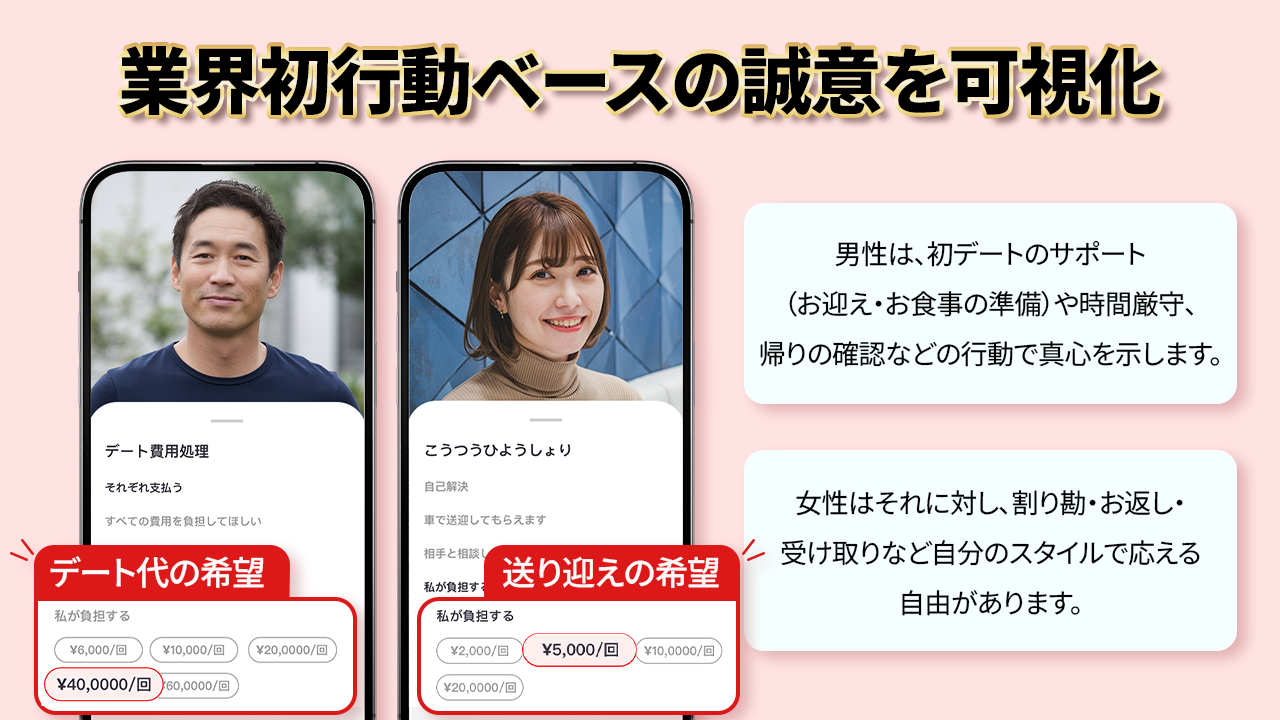
- In an ideal relationship, what kind of efforts would we not spare for each other? Is it prioritizing time together, providing financial support, offering emotional support, or working towards common goals? For example, whether to consider a man covering the meal on the first date as “natural” or “thankful, but it should be decided mutually” reflects your values.
- What are the core values I cannot compromise on?
- What values do I absolutely want the other person to share? Please articulate specifically, such as “Valuing family,” “Respecting individual growth,” or “Honest communication.”
Map of Optimal Dating Venues by Purpose: Expanding Your Options
Once you deepen your self-understanding, consider applying it to your choice of dating venues.
- If you think… “I want to challenge myself to meet and gain experience with many people.”
- Dating cafés and matching apps can serve as “one option” to gain a certain level of experience. However, it is crucial to approach it as a short-term experience with an understanding of the aforementioned psychological costs.
- If you are seriously looking for a partner who can deeply share values and think about life together.
- Quality is more important than quantity in encounters. Engaging in natural interactions within hobby communities (book clubs, sports clubs, volunteering) or considering a platform that has “clarity of intent” and “deep compatibility” as its design philosophy might actually be a shortcut that seems lengthy.
- If you wish to eliminate games and ambiguity, starting with sincere dialogue.
- Marriage hunting parties or services that deeply encourage self-disclosure from the profile creation stage and match based on inner values could be a good fit.
Three Pillars that Form the Foundation of Healthy Relationships
No matter where you meet, lasting relationships that help each other grow share common foundations.
- Mutual Respect: Treating the other as an individual with respect, not denying thoughts or feelings. Avoid creating hierarchies economically or mentally.
- Transparency of Intent: The courage and habit of communicating from the early stages of the relationship what you seek and what you do not want.
- Emotional Safety: Feeling secure that you will not be rejected even if you show weakness or have differing opinions. This sense of safety is essential for cultivating true intimacy.
Yoitoki’s “Clarity of Intent” places this second pillar at the core of our service. Our “Kokoromusubi AI” analyzes the emotions and priorities underlying your answers, preparing encounters with those who are likely to foster these three pillars naturally. This will be the next step towards building relationships that resonate with your true self.
New Options: Human-Like Encounters Deepened by Technology
So, is “efficiency” truly at odds with “deep human connections”? The evolution of technology is opening new possibilities that transcend this binary. It’s a paradigm shift that creates paths for more human-like and essential connections with the help of algorithms.
The Evolution of AI Matching: Compatibility Based on Deep Psychology
Traditional matching focused on superficial commonalities such as “shared hobbies” or “similar hometowns” and preferences based on appearance. However, the satisfaction of long-term relationships is determined by more than that. Modern AI matching can now analyze deeper psychological and value layers, such as “emotional needs” (how one wants to be loved and recognized), “commitment styles” (what kind of stability and freedom one seeks in a relationship), and “priorities in life” (balancing work, family, and personal growth). This helps find compatibility closer to the conviction that “with this person, I can overcome challenges,” beyond mere “liking.”
Designing the Quality of Communication: The Importance of Guided Dialogue
Instead of throwing people into a one-on-one free chat right away, there is a concept of designing the start of a relationship. For example, after matching, experiencing guided dialogues (such as question cards) to confirm each other’s values. Alternatively, during the profile creation stage, answering questions that clearly express intentions such as “What do I value most in life?” and “What are the most important qualities I seek in a partner?” These strategies create a space for expressing mutual intent as the first step of mutual effort, rather than relying on chance or impulse. From the first conversation, it significantly reduces the anxiety of “not knowing what to talk about,” largely mitigating the risks of fundamental misunderstandings.
Voices of Successful Individuals: Mutual Understanding Born from Value Alignment
(Experience of A, a man in his late 30s, engineer) “I used to use matching apps, but when I met people, I often found that conversations didn’t align, and the direction of what we were seeking was different. The act of ‘searching for the next person’ became a goal in itself, and I felt exhausted. With Yoitoki, it took time to answer the deeper questions during profile creation, but that was actually beneficial. From the first message, I was able to discuss core topics like our views on work and how we feel about loneliness. Meeting, I felt reassured that ‘this person understands me not by my title or appearance, but by my way of thinking.’ Now, I feel that we are walking together towards the same goal.”

This experience indicates that the success of encounters is not about “meeting many people,” but about whether you can start meaningful dialogue with someone who resonates on the point of “deep compatibility.” Technology is evolving as a tool to enhance the probability of that discovery, allowing you to concentrate your precious time and emotional energy on more meaningful encounters.
Frequently Asked Questions (FAQ)
Q1. Are dating cafés suitable for those seriously considering love or marriage?
A. Due to their structure, initial stages put strong emphasis on appearance and instant impressions, making it less than optimal for those who wish to slowly confirm inner values and long-term life plans. If you seek a serious relationship, it may be a shortcut to find a place where both parties can express their intentions from the start and choose based on substance beyond profiles.
Q2. Does the system of women being free distort the power dynamics in relationships?
A. As you pointed out, the asymmetry of economic burdens can unconsciously complicate starting from an equal footing. We believe that healthy relationships begin with mutual respect and emotional equality. Ideally, both parties should be able to participate with equal interest and sincerity from the outset.
Q3. How can I efficiently meet people with aligned values?
A. One way is to choose services that delve into not only hobbies and backgrounds but also the underlying values and emotions behind “why that is important.” For example, our “Yoitoki”’s “Kokoromusubi AI” does not merely match based on keywords but analyzes the emotions and priorities behind your responses, introducing you to potential partners who resonate on a fundamental level.
Q4. Can intentions be clarified on matching apps?
A. It is possible, but many general apps tend to prioritize “a lot of options” and “speed,” which can limit the space for in-depth expressing and understanding of intentions. If you wish to value “the destination of relationships” from the start, look for platforms focused on “serious encounters” that encourage careful self-disclosure and mutual understanding right from the profile creation stage.
Q5. How can busy professionals secure time to build deep relationships?
A. The key is to shift focus from “the number of encounters” to “the quality of encounters.” Choose to spend time with a small number of highly compatible partners, engaging in meaningful dialogues. For that, utilizing services that conduct pre-screening based on deep compatibility can be a modern solution that maximizes the respect for your valuable time and emotional energy.
Conclusion: Towards Genuine Connections Born from Mutual Effort
A dating café is one answer to modern loneliness and a society that must prioritize efficiency. However, we have seen that behind that light lies significant psychological costs and important trade-offs regarding the quality of relationships.
If we truly seek relationships that fulfill our hearts, we need to pause and rethink. The question should not be “How can I meet efficiently?” but rather, “What kind of relationship do I want to build, and on what foundation?”
The answer lies in the ongoing mutual effort of respecting each other’s values, articulating intentions, and accumulating small acts of consideration. Only in a soil of transparency and safety from the start can relationships bloom with their inherent richness and depth.

Shall we start a new form of encounter?
If you are tired of ambiguous relationships, and seek connections built on mutual effort and true understanding, your place is here.